The name TB-500 can be confusing because it is often used alongside thymosin beta-4. However, these names do not necessarily describe the same research material.
In simple terms, TB-500 is a short synthetic peptide based on a specific region of thymosin beta-4.
Understanding that distinction is important when reviewing a certificate of analysis, comparing research papers or preparing a sample for laboratory analysis.
What Is TB-500 Peptide?
TB-500 peptide is generally identified as an N-terminally acetylated seven-amino-acid peptide with the sequence:
Ac-LKKTETQ
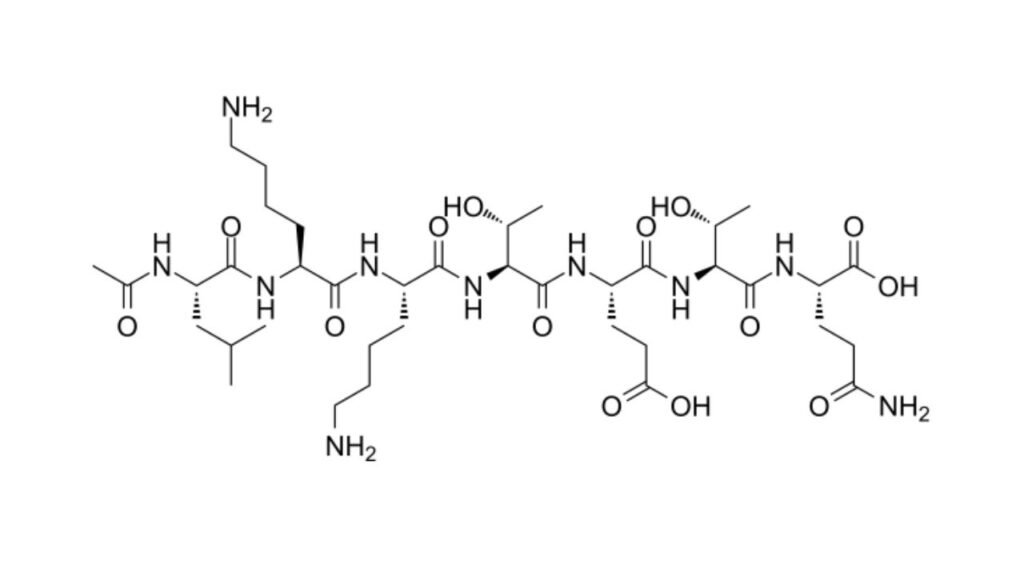
This sequence corresponds to amino-acid residues 17-23 within thymosin beta-4. It forms part of the parent molecule’s central actin-binding region.
Analytical studies have identified this acetylated fragment in materials labelled as TB-500 and have used techniques such as liquid chromatography and high-resolution mass spectrometry to confirm its structure.
The important point is that TB-500 is a peptide fragment rather than the complete thymosin beta-4 molecule.
Are TB-500 and Thymosin Beta-4 Identical?
Thymosin beta-4 is a much longer naturally occurring peptide associated with the binding and regulation of actin, an important structural protein used in laboratory studies of cellular organisation and movement.
TB-500 represents only the short LKKTETQ region, with an acetyl group added to its N-terminus.
This difference matters because research performed on full-length thymosin beta-4 cannot automatically be treated as research on TB-500.
The two materials have different sequences, molecular sizes and analytical profiles.
A 2024 analytical study also noted that the biological characteristics of the parent TB-500 fragment itself remain less thoroughly documented than those of related thymosin beta-4 sequences.
Why is TB-500 Peptide Studied in Laboratories?
TB-500 is primarily used as a research material when investigating:
- Peptide structure and characterisation
- Actin-binding peptide sequences
- Cellular and biochemical assay systems
- Peptide stability and breakdown products
- Analytical detection methods
- Fragment and metabolite identification
Some studies focus specifically on separating TB-500 from its smaller breakdown products using UHPLC and high-resolution mass spectrometry.
This helps researchers confirm which sequence is present in a sample rather than relying only on the product name or vial label
Can Appearance Confirm TB-500 Identity?
No. A white or off-white research powder cannot be identified reliably by appearance alone.
Identity and purity normally require appropriate analytical documentation, such as HPLC and mass spectrometry results.
Analytical studies of TB-500 have used chromatographic separation and accurate mass measurements to distinguish the parent peptide from related fragments.
Note: This article is for educational and research information only. Products discussed are intended for laboratory research use only and are not for clinical, food, cosmetic, veterinary, or household applications.
Frequently Asked Questions
Is TB-500 the same as thymosin beta-4?
No. TB-500 is generally described as the acetylated seven-amino-acid sequence Ac-LKKTETQ, while thymosin beta-4 is the larger parent peptide.
What is the amino-acid sequence of TB-500?
The sequence commonly identified in analytical literature is Ac-LKKTETQ, representing the acetylated 17-23 region of thymosin beta-4.
What does “Ac” mean in Ac-LKKTETQ?
“Ac” indicates that an acetyl group has been added to the peptide’s N-terminus. This modification forms part of the analytical identity commonly associated with TB-500.
How can a laboratory confirm TB-500 identity?
Confirmation may involve reviewing the certificate of analysis and using techniques such as HPLC, liquid chromatography–mass spectrometry or high-resolution mass spectrometry.
Can TB-500 be identified from the powder’s appearance?
No. Colour and texture are not reliable methods of peptide identification, purity assessment or degradation testing.
Should TB-500 and thymosin beta-4 research be grouped together?
Not automatically. Research records should clearly distinguish between the short TB-500 fragment and the full-length parent peptide.
Sources
- Analytical identification of the acetylated thymosin beta-4 fragment:
https://pubmed.ncbi.nlm.nih.gov/22962027/ - Doping control analysis and structural identification of TB-500:
https://pubmed.ncbi.nlm.nih.gov/23084823/ - TB-500 and metabolite analysis using UHPLC high-resolution mass spectrometry:
https://doi.org/10.1016/j.jchromb.2024.124033 - Mapping the actin-binding site of thymosin beta-4:
https://pubmed.ncbi.nlm.nih.gov/8617195/ - Structural study of thymosin beta-4 and actin:
https://pmc.ncbi.nlm.nih.gov/articles/PMC517612/ - PubChem record for TB-500:
https://pubchem.ncbi.nlm.nih.gov/compound/62707662 - PubChem record for TB-500 acetate:
https://pubchem.ncbi.nlm.nih.gov/compound/155977548 - PubChem record for TB-500 trifluoroacetate salt:
https://pubchem.ncbi.nlm.nih.gov/compound/169446757