When a laboratory orders a synthetic peptide, the material has usually gone through far more than simply “mixing amino acids together”.
A defined sequence has to be assembled in the correct order, separated from unwanted reaction products, checked analytically and then prepared in a form suitable for controlled research storage.
For many synthetic research peptides, the most widely used approach is solid-phase peptide synthesis (SPPS), particularly the Fmoc method.
Here is what that process actually involves.
What Is Peptide Synthesis?
A peptide consists of amino acids joined together by peptide bonds.
During chemical peptide synthesis, those amino acids are added in a predetermined sequence.
The challenge is making sure each amino acid connects at the correct position while preventing other reactive parts of the molecules from reacting at the wrong time.
This is why peptide synthesis commonly uses:
- a solid resin support
- protected amino acids
- coupling chemistry
- repeated protection and deprotection steps
- purification after synthesis
- analytical testing to confirm the resulting research material
The important point is that assembling the sequence is only one part of producing a well-characterised peptide.
Purification and analytical verification are also important stages.
What Is Solid-Phase Peptide Synthesis?
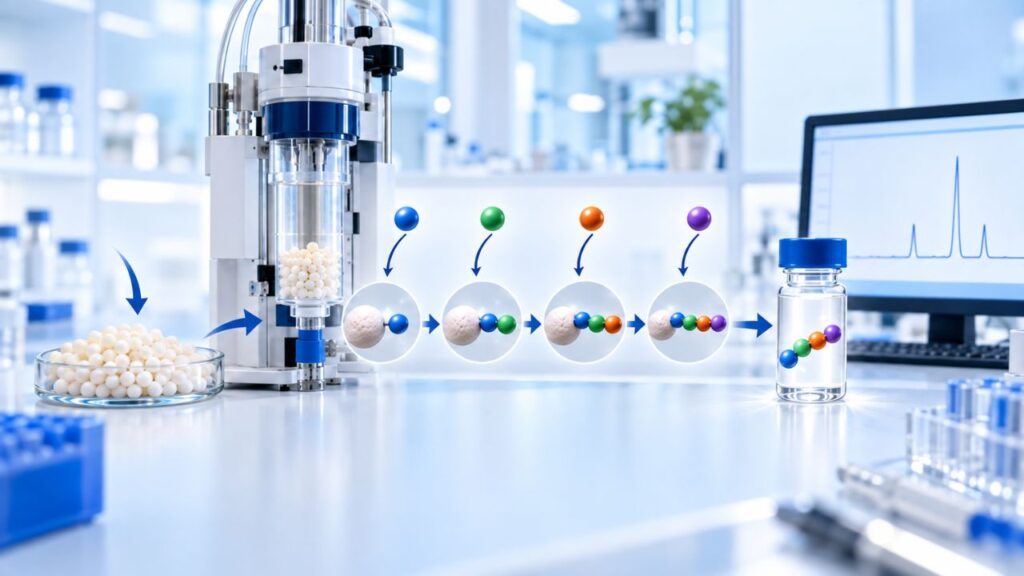
Solid-phase peptide synthesis keeps the growing peptide chain attached to an insoluble material known as a resin.
The first amino acid is attached to this resin. Additional amino acids can then be added one at a time while the peptide remains anchored in place.
In conventional SPPS, the chain is generally assembled from its C-terminus towards its N-terminus.
Keeping the peptide attached to a solid support makes repeated reaction and washing steps easier because excess reagents and reaction by-products can be washed away while the growing peptide remains attached to the resin.
SPPS has become the primary chemical method for producing many synthetic peptides.
How The Peptide Chain Is Built?
Modern SPPS usually follows a repeating cycle.
1. The first amino acid is attached to the resin
The process begins with a suitable solid support.
The amino acid that will form the end of the target sequence is attached to this resin through a chemical linker.
The growing peptide remains connected to the support during most of the synthesis.
2. Reactive groups are temporarily protected
Amino acids contain several chemical groups that may react under synthesis conditions.
To prevent unwanted reactions, selected groups are temporarily blocked with protecting groups.
One commonly used strategy uses the Fmoc protecting group on the amino group involved in chain extension. Other protecting groups may be used on amino acid side chains.
Think of these protecting groups as temporary covers. They stop particular parts of the molecule from reacting until the appropriate stage of the synthesis.
3. The Fmoc group is removed
Before the next amino acid can be added, the temporary Fmoc protection on the growing chain is removed.
This exposes the reactive amino group required for the next coupling reaction.
The material can then be washed before moving to the next stage.
4. The next amino acid is coupled
The next protected amino acid in the sequence is introduced.
Coupling chemistry promotes the formation of a peptide bond between the incoming amino acid and the growing chain.
Once the reaction is complete, excess material and reaction products can be washed away again.
5. The cycle repeats
The same general sequence continues:
Deprotect → wash → couple → wash → repeat
Each cycle extends the peptide chain by one amino acid.
Many modern peptide synthesisers can automate much of this repeated process.
For a peptide containing many amino acids, however, small inefficiencies can accumulate from one cycle to the next. This is one reason longer or chemically difficult sequences can be more challenging to manufacture cleanly.
What Happens After The Sequence Is Complete?
Finishing the amino-acid sequence does not mean the peptide is ready for research.
The newly assembled peptide still needs to be separated from the resin and, where applicable, remaining side-chain protecting groups must be removed.
This stage is normally called cleavage and deprotection.
The resulting material is often described as the crude peptide.
Crude material may contain the intended peptide alongside unwanted components created during synthesis, such as incomplete sequences or reaction by-products.
Purification is therefore an important next step.
How Are Synthetic Peptides Purified?
One of the most widely used techniques for synthetic peptide purification is reversed-phase high-performance liquid chromatography, commonly abbreviated as RP-HPLC.
In simple terms, HPLC separates compounds according to how they interact with the chromatography system.
The crude peptide mixture passes through a column, and different components move through it differently. Fractions containing the target research material can then be collected.
Depending on the sequence and required specification, further purification or analytical work may be necessary.
This is why a stated peptide purity refers not simply to successful synthesis, but to what is observed using a particular analytical method after manufacturing and purification.
Why Are Some Peptides Lyophilised?
After purification, synthetic peptide material may be converted into a dry form using lyophilisation, or freeze-drying.
During lyophilisation, a solution is frozen and water is subsequently removed under reduced pressure.
This can produce a dry powder or porous cake that is easier to package and manage as research material than the original purification solution.
Lyophilisation is also used when preparing carefully characterised peptide reference materials.
This does not mean that every lyophilised peptide has identical storage characteristics.
Stability remains dependent on the particular sequence, formulation, residual moisture, packaging and stated storage conditions.
Frequently Asked Questions
How are most synthetic research peptides made?
Many are produced using solid-phase peptide synthesis, particularly Fmoc-based SPPS. Amino acids are added sequentially while the growing peptide remains attached to a resin.
Are peptides made one amino acid at a time?
In conventional SPPS, yes. Protected amino acids are usually coupled sequentially according to the required peptide sequence.
What does Fmoc mean in peptide synthesis?
Fmoc is a temporary protecting group used during peptide chain assembly. It protects the reactive amino group until the next synthesis cycle begins.
Why does peptide synthesis use a resin?
The resin holds the growing peptide in place while reagents and reaction by-products can be washed away between synthesis steps.
Is every peptide equally easy to synthesise?
No. Sequence length, amino acid composition, aggregation, and chemical side reactions can all affect the difficulty of synthesis and purification.
Compliance note
“This article is for educational and research information only. Products discussed are intended for laboratory research use only and are not for clinical, food, cosmetic, veterinary, or household applications.”
Sources
- Behrendt R, White P, Offer J. Advances in Fmoc solid-phase peptide synthesis. Journal of Peptide Science. Read the full article on PubMed Central
- Amblard M, Fehrentz J-A, Martinez J, Subra G. Methods and protocols of modern solid phase peptide synthesis. View the PubMed record
- Fields GB. Introduction to Peptide Synthesis. Read the full article on PubMed Central
- Hansen PR, Oddo A. Fmoc Solid-Phase Peptide Synthesis. View the PubMed record
- Mass-Based Fraction Collection of Crude Synthetic Peptides in Analytical and Preparative Scale. Read the full article on PubMed Central
- Reference Standards to Support Quality of Synthetic Peptide Therapeutics. Read the full article on PubMed Central