Making a peptide one amino acid at a time sounds straightforward. But the difficulty is keeping the growing chain under control while repeatedly adding new amino acids and removing unwanted reaction materials.
Solid-phase peptide synthesis (SPPS) solves much of this problem by keeping the growing peptide attached to a solid material called a resin.
Instead of repeatedly isolating the peptide after every reaction, researchers can wash unwanted material away while the peptide remains attached to the solid support.
This makes repeated synthesis cycles easier to manage and is one reason SPPS has become a widely used method for preparing synthetic peptide research materials.
What Is Solid-Phase Peptide Synthesis (SPPS)?
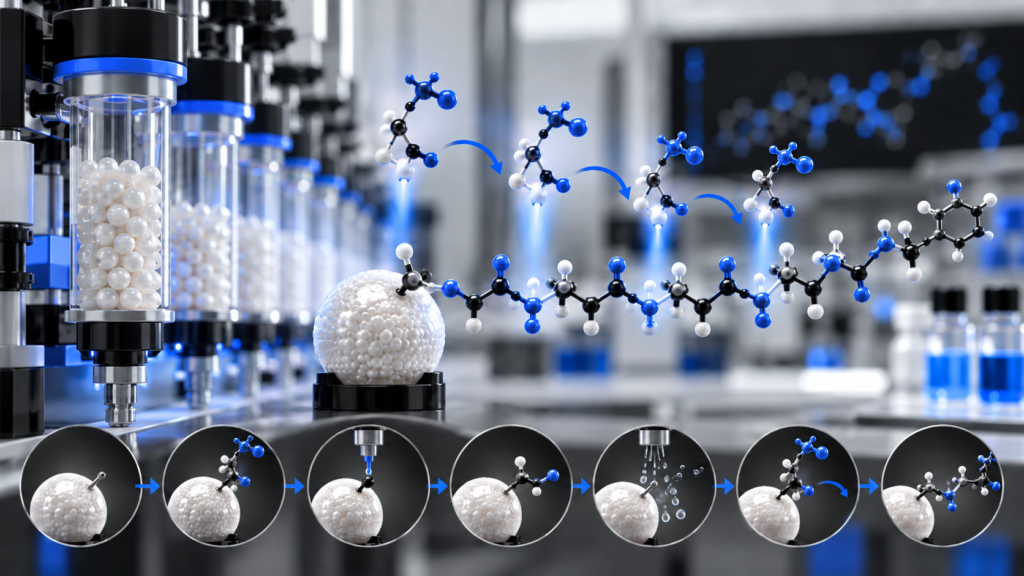
In simple terms, SPPS builds a peptide chain while one end of that chain is temporarily attached to an insoluble resin.
The method was introduced by R. Bruce Merrifield in the 1960s. His approach allowed amino acids to be added sequentially while the growing peptide remained anchored to a polymer support.
Merrifield later received the 1984 Nobel Prize in Chemistry for his work on solid-phase methodology.
The important point is that the peptide stays attached to the resin during most of the synthesis.
Soluble reagents can therefore be added, allowed to react and then removed by filtration and washing.
The next synthesis step can then begin without having to isolate the growing peptide from solution each time.
How Does SPPS Work?
SPPS is normally a repeating process.
The peptide is generally assembled from its C-terminus towards its N-terminus.
The first amino acid is attached to the resin through a suitable linker. Additional amino acids are then added sequentially.
A simplified SPPS cycle looks like this:
- Attach the first amino acid to the resin. The C-terminal amino acid is connected to the solid support through a linker.
- Remove the temporary protecting group. This exposes the reactive amino group needed for the next step.
- Couple the next amino acid. A protected amino acid is activated and joined to the growing peptide, forming a new peptide bond.
- Wash the resin. Excess reagents and soluble reaction products are removed, leaving the peptide attached.
- Repeat the cycle. Deprotection and coupling continue until the required sequence has been assembled.
- Release the peptide. After chain assembly, the peptide is cleaved from the resin and appropriate side-chain protecting groups are removed.
These repeated deprotection and coupling cycles are the central idea behind SPPS.
Why Are Protecting Groups Needed?
An amino acid can contain several chemically reactive groups.
If all of them were allowed to react freely during synthesis, unwanted bonds and side products could form.
SPPS therefore uses protecting groups to temporarily block selected reactive sites.
The group protecting the growing end of the chain is removed when the next amino acid is added, whereas other sensitive groups can remain protected until later in the synthesis.
Two important SPPS strategies are based on Fmoc and Boc chemistry. Modern laboratory SPPS commonly uses the Fmoc approach.
This does not mean that Fmoc determines the peptide sequence. It is simply part of the chemical strategy used to control when particular groups are available to react.
What Does The Resin Actually Do?
The resin is more than just a place to hold the peptide.
It provides an insoluble support that physically separates the growing chain from soluble reagents. This means excess reaction material can be washed away without removing the peptide itself.
Different resins and linkers can also influence the chemistry of the synthesis and the form of the peptide produced after cleavage.
For laboratory research material, information about the resin, linker and synthesis strategy may therefore be relevant when reviewing manufacturing or batch documentation.
Why is SPPS Useful for Peptide Synthesis?
The main advantage is convenience during repeated reaction cycles.
In traditional solution-based approaches, intermediate products may need to be isolated between reaction stages.
With SPPS, the resin-bound peptide can remain in the reaction vessel while excess soluble material is removed through washing.
This also makes SPPS well-suited to automation because coupling, deprotection and washing can be repeated as controlled cycles.
However, SPPS does not guarantee that every peptide sequence will be easy to produce.
Sequence length, amino-acid composition, aggregation, incomplete reactions and side reactions can all affect the final crude material.
What to Check When Reviewing an SPPS-produced Research Peptide
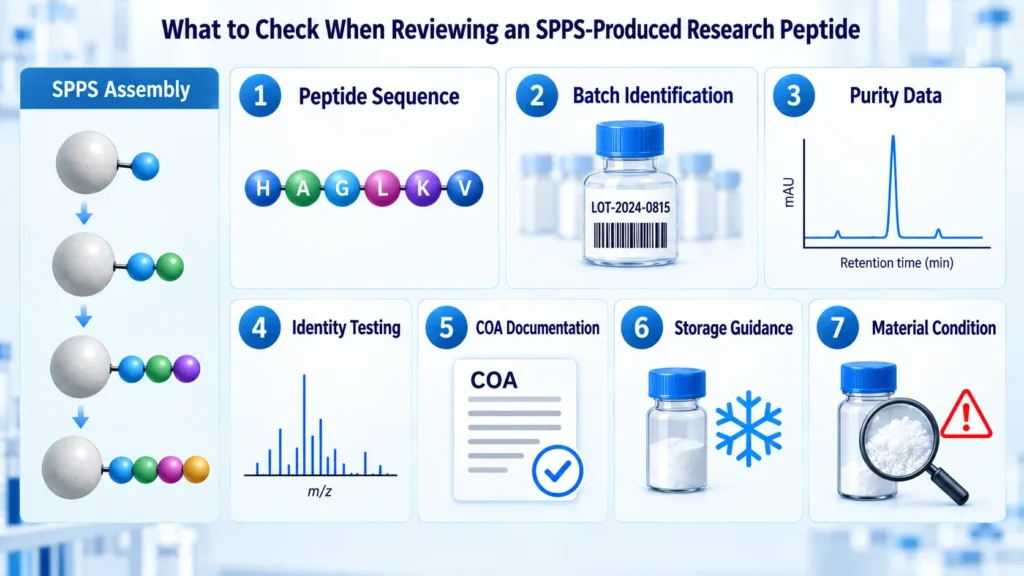
For laboratory research material, useful information to review includes:
- Peptide sequence – does the documented sequence match the required research material?
- Batch identification – is the material traceable to a specific production batch?
- Purity data – what analytical method was used and what does the reported result actually represent?
- Identity testing – is appropriate mass or other structural analytical information available?
- COA documentation – are the batch number, test methods and reported specifications clearly stated?
- Storage guidance – are storage conditions provided for the supplied physical form?
- Material condition – are there unexpected visible changes or evidence of moisture or packaging problems?
The main point is that SPPS describes how the peptide chain is assembled; it does not by itself establish the quality of the final research material.
Purification, analytical testing, batch documentation and appropriate laboratory storage all remain separate considerations.
SPPS vs Peptide Purity
It is easy to see “solid-phase peptide synthesis” on documentation and assume that this says something about purity.
It does not.
SPPS is a synthesis method. Purity is an analytical characteristic of the resulting material.
A batch produced through SPPS can still contain deletion sequences, reaction by-products or other impurities.
The finished research material therefore needs appropriate analytical characterisation rather than relying on the synthesis method alone.
Frequently asked questions
What does SPPS stand for?
SPPS stands for solid-phase peptide synthesis, a method in which a peptide is assembled step by step while attached to an insoluble solid support.
Who developed solid-phase peptide synthesis?
R. Bruce Merrifield introduced the solid-phase approach to peptide synthesis in the 1960s and received the 1984 Nobel Prize in Chemistry for his work.
What is the solid phase in SPPS?
The solid phase is typically a polymer resin. The growing peptide remains chemically attached to this resin during repeated synthesis cycles.
What is Fmoc SPPS?
Fmoc SPPS uses the Fmoc group as temporary protection for the amino group involved in peptide chain extension. It is one of the most commonly used modern SPPS strategies.
Does SPPS produce a pure peptide automatically?
No, SPPS produces crude material that may contain incomplete sequences and other synthesis-related impurities. Purification and analytical characterisation are separate stages.
Compliance note
“This article is for educational and research information only. Products discussed are intended for laboratory research use only and are not for clinical, food, cosmetic, veterinary, or household applications.”
Sources
- Methods and protocols of modern solid phase peptide synthesis – PubMed
- Advances in Fmoc solid-phase peptide synthesis – PubMed Central
- Introduction to Peptide Synthesis – PubMed Central
- Bruce Merrifield – Nobel Lecture, NobelPrize.org
- Fundamental Aspects of SPPS and Green Chemical Peptide Synthesis – PubMed Central
- Characterization of Synthetic Peptides by Mass Spectrometry – PubMed