A peptide Certificate of Analysis (COA) might show 99% purity, while another line gives a noticeably lower peptide content percentage.
At first, those figures can look contradictory but they are not.
The important point is that peptide purity and peptide content measure different things.
Purity normally describes the relative composition seen during chromatographic analysis, while peptide content describes how much of the total weighed research material is actually peptide.
Understanding the difference makes laboratory documentation much easier to interpret.
Peptide Purity vs Peptide Content At A Glance
| Measurement | What It Tells You | Common Analytical Approach |
| Peptide purity | How dominant the target peptide peak is compared with other detected peaks | RP-HPLC with UV detection |
| Peptide content | How much of the weighed material consists of peptide rather than water, counter-ions and other non-peptide material | Often amino acid analysis or another quantitative method |
| Peptide identity | Whether the material corresponds to the expected peptide | Mass spectrometry |
These measurements complement each other rather than replacing one another. Analytical RP-HPLC is commonly used to evaluate peptide purity, while mass spectrometry provides additional information about peptide identity.
What Does Peptide Purity Mean?

Peptide purity is usually reported from an analytical reversed-phase HPLC (RP-HPLC) chromatogram.
The sample is separated as it passes through the chromatographic system. The detector records peaks corresponding to components that are detected under the chosen analytical conditions.
If the target peptide produces 99% of the relevant integrated chromatographic peak area, the COA may report approximately 99% HPLC purity.
In simple terms, purity asks:
How dominant is the target peptide peak compared with the other detected peaks?
Other peaks may represent synthesis-related or degradation-related material, such as incomplete sequences or chemically modified peptide species. RP-HPLC with UV detection is an established approach for examining this type of peptide impurity profile.
However, a 99% HPLC purity result does not automatically mean that 99% of the entire lyophilised material by weight is target peptide.
That distinction is where peptide content becomes important.
What Does Peptide Content Mean?
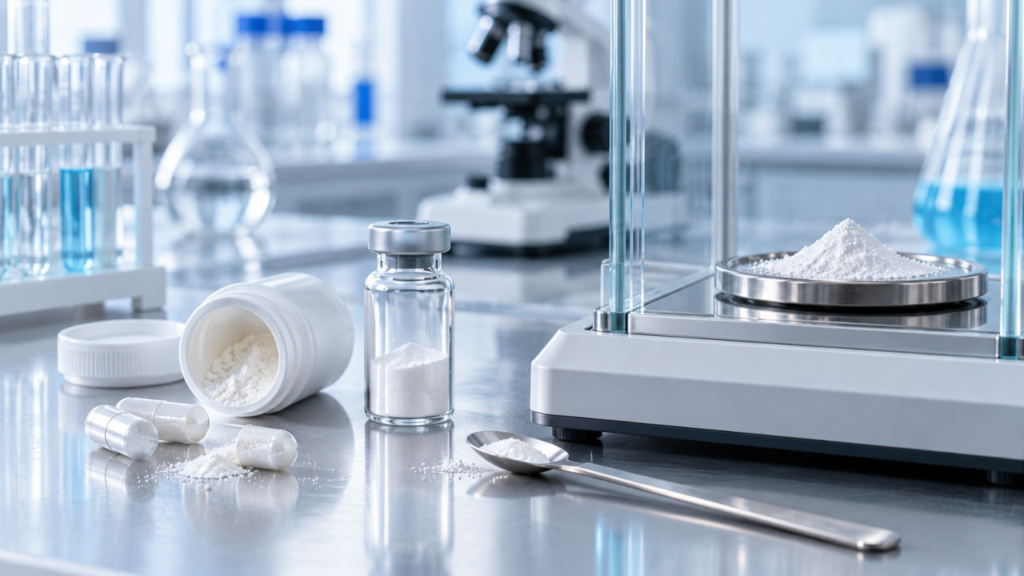
Peptide content, sometimes called net peptide content, looks at the material from a different perspective.
It describes the proportion of a gravimetrically measured sample that consists of peptide rather than non-peptide material.
Synthetic peptide preparations can contain additional mass from components such as:
- residual water
- counter-ions associated with the peptide
- residual salts or other process-related material
A peer-reviewed consensus paper on peptide handling and quantification defines net peptide content as the amount of actual peptide within a gravimetrically measured sample and specifically notes that water and counter-ion mass are excluded. Amino acid analysis is commonly used for this determination.
Quantitative amino acid analysis is also used by NIST for assigning concentration values to peptide and protein reference materials.
Why Can A Peptide Be 99% Pure But Only 80% Peptide Content?
This is probably the easiest way to understand the difference.
Imagine a laboratory sample contains 10 mg of total lyophilised material.
The analytical documentation reports:
HPLC purity: 99%
Net peptide content: 80%
The 80% content figure means approximately 8 mg of the 10 mg total material is peptide material, based on the method used to determine content.
The remaining mass may include water, counter-ions and other non-peptide components.
The 99% purity figure answers a separate question. It describes the relative chromatographic signal associated with the target peak compared with the other integrated peaks under the HPLC method.
Therefore, both numbers can be correct.
Why Doesn’t HPLC Purity Measure Peptide Content?
HPLC is primarily separating and comparing components according to their chromatographic behaviour and detector response.
Routine peptide HPLC commonly uses UV detection around the region where peptide bonds can be detected. Thermo Fisher, for example, documents peptide HPLC analysis using UV detection at 214 nm.
But not every component contributing to the physical weight of lyophilised research material produces an equivalent UV response.
Water is an obvious example. Counter-ions and inorganic material may also contribute to sample mass without appearing as peptide peaks in the same way.
This means that chromatographic area percentage and percentage by sample weight are not interchangeable measurements.
What About Counter-Ions?
Counter-ions are one important reason peptide content can be lower than the total weight of a sample.
During peptide purification, acids such as trifluoroacetic acid may be used as mobile-phase additives or ion-pairing reagents. Peptides can consequently be isolated in a salt form containing associated counter-ions. Reverse-phase peptide chromatography using TFA is well established.
Those counter-ions contribute physical mass.
They do not necessarily indicate poor chromatographic purity.
For research documentation, the difference matters because sample weight, HPLC purity and actual peptide content describe different characteristics of the same material.
How Is Peptide Content Measured?
Amino acid analysis (AAA) is one established approach.
The peptide is hydrolysed into its constituent amino acids, which can then be quantitatively analysed. The results can be used to determine the amount of peptide represented by the measured sample.
Research from NIST describes amino acid analysis as an important quantitative technique for assigning concentration values to peptide reference materials.
Other validated quantitative methods may also be used depending on the laboratory protocol and purpose of the analysis. NIST research comparing peptide quantification techniques has examined approaches including HPLC-based assay methods, quantitative NMR and amino acid analysis.
The important point is to check which analytical method produced the content result, rather than assuming every percentage on a COA was generated by HPLC.
Does High Purity Guarantee High Peptide Content?
No.
A research material could show a very high chromatographic purity while having a lower net peptide content because part of its physical mass consists of water and counter-ions.
The reverse distinction also matters. A content measurement alone does not provide a complete chromatographic impurity profile.
For that reason, purity and content should be interpreted as separate pieces of analytical information.
What To Check On A Peptide COA

When reviewing batch documentation for controlled laboratory research, look beyond the largest percentage printed on the report.
Check whether the COA clearly identifies HPLC purity, rather than simply using the word “purity”. Look for the chromatogram and analytical method where available.
Next, check whether peptide content or net peptide content has actually been measured. If it has, the documentation should ideally identify the analytical method.
Mass spectrometry information should also be considered separately. MS can help establish that the detected material has the expected molecular characteristics, but it should not be confused with either HPLC purity or net peptide content.
Finally, review information about the batch’s salt or counter-ion form and any reported water determination when these are relevant to the laboratory protocol.
What If The COA Only Shows HPLC Purity?
Do not assume peptide content from the HPLC percentage.
Instead, check the batch documentation to determine whether a separate peptide-content assay was performed.
A COA containing HPLC and mass spectrometry results can provide useful information about purity and identity, but that does not automatically mean the batch’s net peptide content was quantitatively determined.
For controlled research preparation where exact material concentration is important, laboratories should work from the analytical information provided for that specific batch and follow the applicable laboratory protocol.
Frequently Asked Questions
Is Peptide Purity The Same As Peptide Content?
No. Purity normally describes the relative chromatographic contribution of the target peptide, while peptide content describes how much of the weighed material is peptide.
Can A Peptide Have 99% Purity And Lower Peptide Content?
Yes. Water, counter-ions and other non-peptide material can contribute to total sample weight without necessarily reducing the HPLC purity percentage.
Does 99% HPLC Purity Mean 99% Of The Powder Is Peptide?
No. HPLC purity is generally based on chromatographic peak response rather than the total physical mass of the lyophilised material.
What Is Net Peptide Content?
Net peptide content is the amount of peptide present within a gravimetrically measured sample after accounting for non-peptide mass such as water and counter-ions.
How Is Peptide Content Tested?
Amino acid analysis is an established quantitative approach. Other validated analytical methods may also be used depending on the laboratory and analytical protocol.
Does Mass Spectrometry Measure Peptide Purity?
Mass spectrometry is primarily useful for characterising and confirming peptide identity. Purity is commonly assessed separately using analytical RP-HPLC with UV detection.
Final Point
Peptide purity and peptide content may both appear as percentages, but they should not be treated as interchangeable.
Purity indicates the chromatographic composition of the sample. Peptide content tells you how much of the overall sample mass is peptide.
For laboratory researchers reviewing batch documentation, understanding that distinction helps prevent incorrect assumptions when interpreting COAs and preparing research materials in accordance with controlled laboratory protocols.
This article is for educational and research information only. Products discussed are intended for laboratory research use only and are not for clinical, food, cosmetic, veterinary, or household applications.
Sources
Peer-reviewed guidance on peptide characterisation, quantification, storage and handling: PMC – Recommendations for the Generation, Quantification, Storage and Handling of Peptides
PubMed record for the same peer-reviewed consensus publication: PubMed – Peptide Generation, Quantification, Storage and Handling Recommendations
NIST information on quantitative amino acid analysis for peptide and protein reference materials: NIST – Isotope Dilution LC-MS/MS for Quantitative Amino Acid Analysis
NIST comparison of peptide quantification methods: NIST – Survey of Peptide Quantification Methods
Thermo Fisher example of peptide HPLC analysis with UV detection at 214 nm: Thermo Fisher Scientific – Peptide HPLC Analysis