If a peptide vial has been left somewhere warmer than intended, exposed to moisture, or repeatedly moved between storage conditions, the obvious question is: has the research material started to degrade?
Unfortunately, there is no single cause of peptide degradation. Heat, moisture, oxygen, light, pH and physical handling can all contribute, and the importance of each factor depends on the peptide sequence and how the sample has been prepared.
The important point is that degradation is not always visible. A sample can look completely normal while chemical changes have already occurred.
What Does Peptide Degradation Actually Mean?
Peptide degradation simply means that the original peptide material has undergone a chemical or physical change.
Chemical degradation can include processes such as oxidation, hydrolysis and deamidation. Physical instability can include aggregation, adsorption to surfaces and precipitation. These processes can alter the composition or purity of a research sample.
What Causes Peptides to Degrade?
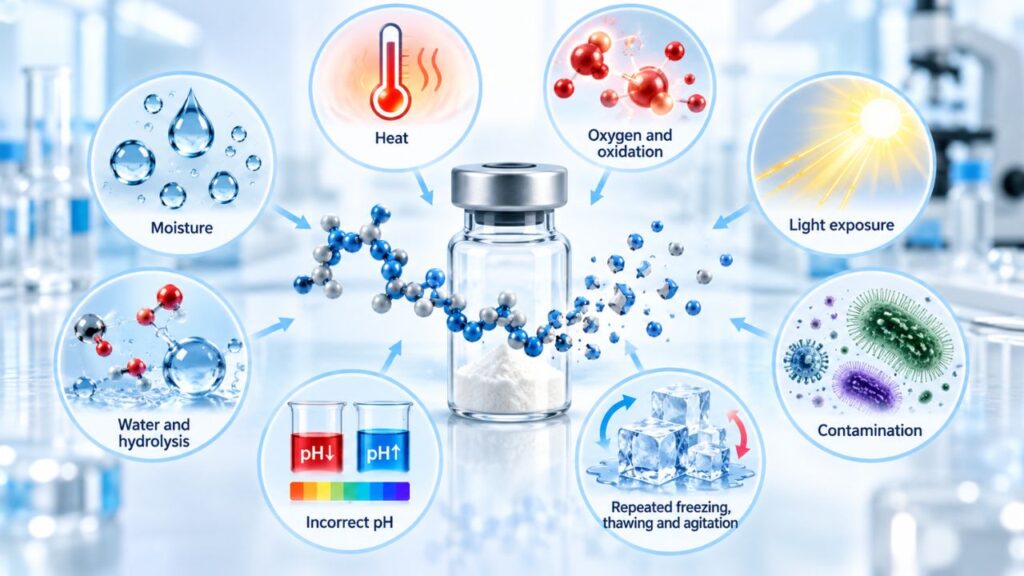
Several factors can accelerate these changes.
Heat
Higher temperatures generally increase the rate of chemical reactions.
This means prolonged exposure to warmer conditions can speed up processes such as oxidation, hydrolysis and other chemical modifications.
A short period outside the recommended storage conditions does not automatically mean that a peptide has completely degraded. Temperature, exposure time, peptide sequence, physical form and packaging all matter.
For research storage, the difference between a brief temperature excursion and prolonged warm storage can therefore be significant.
Moisture
Moisture is particularly important when dealing with dry or lyophilised research material.
Although peptides are often more stable in a dry state than in an aqueous research solution, dry material is not completely immune to degradation. Research has shown that moisture content can influence chemical reactions even in solid peptide and protein preparations.
Repeatedly opening a vial in a humid environment can potentially allow moisture to enter.
In simple terms:
Sealed dry material: generally has less exposure to environmental moisture.
Frequently opened dry material: has more opportunity for moisture and air exposure.
Research solution: water is already present, allowing some degradation pathways to occur more readily.
This is one reason why the distinction between dry and liquid research material matters when evaluating storage history.
Oxygen and Oxidation
Oxidation is one of the best-known peptide degradation pathways.
Certain amino acid residues are particularly susceptible, including methionine and cysteine, while tryptophan, tyrosine and histidine may also undergo oxidative changes under suitable conditions.
Exposure to oxygen, reactive contaminants, light and some trace metals can contribute to oxidative reactions.
The exact sensitivity varies considerably between peptide sequences, which is why storage requirements should be based on the specific batch documentation rather than a universal rule.
Light Exposure
Light can promote chemical changes in light-sensitive compounds and may contribute to peptide oxidation.
Photostability testing is an established part of evaluating the effect of light exposure on chemically sensitive materials.
If laboratory documentation specifies protection from light, the material should therefore remain in suitable protective packaging during research storage.
Leaving a light-sensitive vial exposed on a brightly illuminated laboratory bench for extended periods is not equivalent to controlled storage.
Water and Hydrolysis
Once peptide material is prepared as a research solution, hydrolysis becomes another potential concern.
Hydrolysis involves chemical bond changes involving water and can lead to peptide-chain cleavage or related degradation products. The rate can depend strongly on the peptide sequence and the conditions of the research solution.
This does not mean every peptide research solution degrades rapidly.
It means that dry-material stability cannot automatically be assumed to apply after laboratory preparation in solution.
Incorrect pH
The pH of a research solution can substantially affect peptide stability.
Some degradation reactions are accelerated under more acidic conditions, while others become faster under more alkaline conditions. Deamidation, hydrolysis, isomerisation and other pathways can all be influenced by pH.
There is no single ideal pH for every peptide.
Laboratory preparation should therefore follow peptide-specific research documentation rather than adjusting pH based on a general peptide rule.
Repeated Freezing, Thawing And Agitation
Physical handling can matter as well as chemical storage conditions.
Freezing, heating and agitation can encourage aggregation in some peptide solutions. Peptides can also interact with air–liquid interfaces and laboratory surfaces.
Repeated freeze–thaw cycles may also increase certain stability problems depending on the peptide.
Published recommendations for analytical peptide standards therefore emphasise the evaluation of time, temperature, adsorption, and freeze-thaw behaviour as part of peptide stability assessment.
Where compatible with the laboratory protocol, reducing unnecessary temperature cycling and excessive agitation can help minimise avoidable handling stress.
Contamination
Poor sample handling can introduce another source of instability.
Once a peptide has been prepared in solution, contamination from laboratory equipment, unsuitable containers or microorganisms can potentially affect sample integrity.
Using clean laboratory equipment, appropriate research-grade solvents and controlled sample-handling procedures reduces unnecessary variables.
The main risk is not simply visible contamination. Even relatively small changes may interfere with subsequent analytical work.
Why Do Some Peptides Degrade Faster Than Others?
Two peptide samples stored under identical conditions may not have identical stability.
Their amino acid sequences can make them more or less susceptible to particular degradation pathways.
For example, the presence and position of residues such as methionine, cysteine, asparagine, aspartic acid and tryptophan may influence oxidation, deamidation or other chemical changes.
Other factors can include:
- Peptide concentration
- Research solution pH
- Buffer composition
- Exposure to oxygen
- Moisture content
- Container surfaces
- Temperature
- Light exposure
- Number of freeze–thaw cycles
This is why peptide stability cannot reliably be determined using storage temperature alone.
Dry Vs Liquid Peptide Material
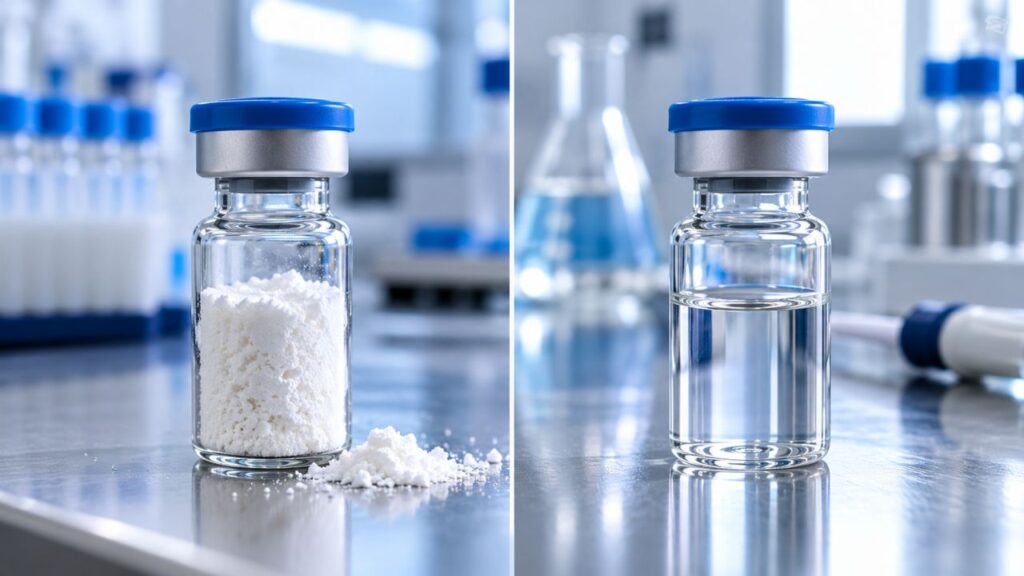
As a general laboratory principle, dry material often has fewer opportunities for water-dependent degradation than the same material in aqueous solution.
However, dry does not mean indestructible.
Temperature, humidity, oxidation and the physical characteristics of the material can still influence solid-state stability.
Once a research solution has been prepared, additional variables including pH, concentration, solvent conditions and physical handling become important.
For research storage, the difference matters because the storage history of the dry material and the prepared solution should be considered separately.
Can You See When A Peptide Has Degraded?
Sometimes there may be visible warning signs.
These could include unexpected:
- Cloudiness
- Precipitation
- Particulate material
- Colour changes
- Changes in solubility
However, appearance alone cannot confirm peptide integrity.
Oxidation, deamidation and other chemical modifications may occur without producing an obvious visual change.
Analytical techniques such as HPLC and mass spectrometry can be used to investigate peptide purity, identity and degradation products where confirmation is required.
What To Check If Storage Conditions Are Uncertain
If a research sample may have experienced unsuitable storage conditions, check the available information before deciding whether it remains suitable for laboratory analysis:
- Storage history: How long was the material outside its specified conditions?
- Temperature exposure: Was it briefly exposed or stored incorrectly for an extended period?
- Moisture exposure: Was dry material opened repeatedly or exposed to humid conditions?
- Light exposure: Was the vial stored according to any light-protection instructions?
- Physical appearance: Are there unexpected changes in colour, clarity or solubility?
- Batch documentation: Review the Certificate of Analysis and any peptide-specific storage guidance.
- Preparation history: Determine whether the material remained dry or had already been prepared as a research solution.
- Analytical requirements: If sample integrity is critical, appropriate analytical testing may be required.
The important point is that storage history usually provides more useful information than appearance alone.
How To Reduce Avoidable Peptide Degradation
For controlled laboratory research, the simplest approach is consistent sample handling.
Keep research material under the conditions specified in its batch documentation, minimise unnecessary exposure to heat, light, air and moisture, and avoid repeatedly moving samples between different temperature conditions unless the laboratory protocol requires it.
For prepared research solutions, use suitable containers and laboratory preparation conditions and minimise unnecessary agitation or repeated freeze–thaw cycles where compatible with the relevant protocol.
Peptide-specific instructions should always take priority because different sequences can have very different stability characteristics.
Frequently Asked Questions
What Is The Most Common Cause Of Peptide Degradation?
There is no single universal cause. Oxidation, hydrolysis, deamidation, heat, moisture and inappropriate solution conditions are among the most important degradation factors.
Does Heat Destroy Peptides Immediately?
Not necessarily. The effect depends on temperature, duration, peptide sequence and whether the material is dry or in solution. Longer or more severe exposure generally presents a greater stability concern.
Does Moisture Damage Lyophilised Peptides?
Moisture can increase molecular mobility and promote chemical reactions in dry peptide material. Minimising unnecessary humidity exposure is therefore important during laboratory storage.
Do Peptides Degrade Faster In Solution?
Many peptides are more susceptible to chemical and physical degradation once prepared in aqueous solution because water, pH and concentration become additional stability variables.
Can Light Degrade Peptides?
Some peptides can be light-sensitive, particularly where light contributes to oxidative reactions. Follow any light-protection instructions provided with the research material.
Research Use Notice
“This article is for educational and research information only. Products discussed are intended for laboratory research use only and are not for clinical, food, cosmetic, veterinary, or household applications.”
Sources
- National Library of Medicine – Solid-State Chemical Stability of Proteins and Peptides
PubMed source - National Library of Medicine / PMC – Peptide Stability and Degradation Pathways in Aqueous Solutions
Read the full review on PMC - National Library of Medicine / PMC – Factors Affecting the Physical Stability and Aggregation of Peptides
Read the full review on PMC - National Library of Medicine / PMC – Recommendations for Peptide Storage and Handling in Mass Spectrometry-Based Assays
Read the full article on PMC - International Council for Harmonisation — Q1B Photostability Guidance
ICH Quality Guidelines - National Library of Medicine / PMC — Analytical Methods for Peptide and Protein Stability
Read the analytical review on PMC