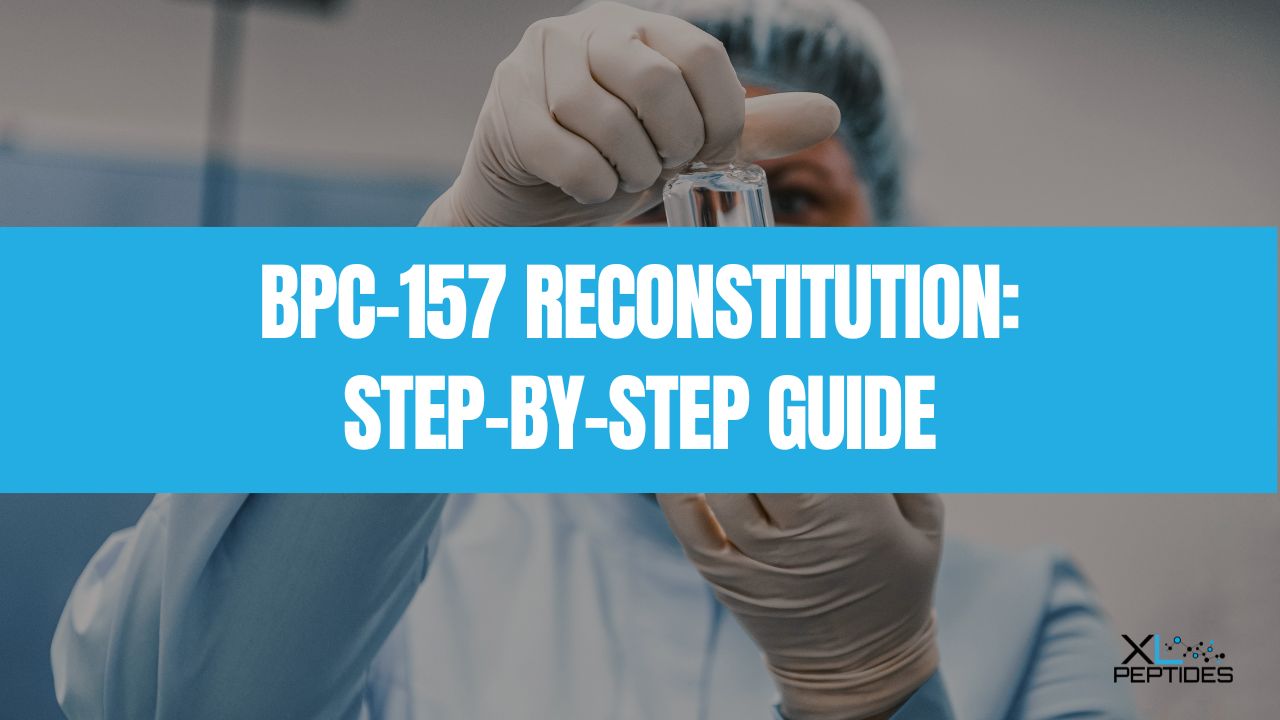
When you buy from a trusted website, BPC-157 is usually supplied as a lyophilised powder.
In simple terms, this means the peptide has been freeze-dried so it can remain more stable before laboratory preparation.
Before it can be used in a research protocol, the powder normally needs to be reconstituted with a suitable sterile liquid. The aim is to create a clear, evenly mixed solution with a known concentration.
This guide explains how BPC-157 reconstitution works in a research-only setting.
It covers what you need, how to choose the right liquid, how to calculate concentration, how to mix the vial correctly, and what to check before storing the prepared solution.
What You Need
Before starting, prepare everything in advance. This keeps the process clean, consistent, and easier to control.
Essential items
- BPC-157 lyophilised vial
- Bacteriostatic water (BAC water) and not sterile water (explained below)
- Sterile measuring syringe or calibrated micropipette
- Alcohol swabs
- Clean gloves
- Sharps-safe disposal container, where applicable
- Permanent marker or vial label
- Clean, flat workspace
Why BPC-157 Reconstitution Matters
Reconstitution is not just “adding water”. It affects concentration accuracy, solution clarity, storage stability, and repeatability in research work.
If too much liquid is added, the final solution becomes weaker than intended. If too little is added, the solution becomes more concentrated and harder to measure accurately.
Whereas, if the liquid is added too forcefully, the peptide cake may foam, cling to the vial, or dissolve unevenly.
Good reconstitution should produce a solution that is:
- Clear or nearly clear
- Free from visible particles
- Correctly labelled
- Stored under suitable conditions
- Easy to calculate for research measurements
The main goal is consistency. Every future measurement depends on the concentration created during this step.
Bacteriostatic Water vs Sterile Water
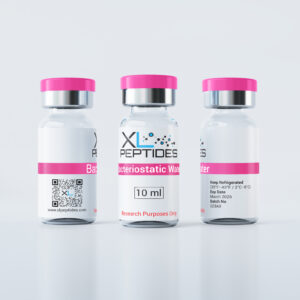
For many research peptide preparations, bacteriostatic water is commonly selected because it contains a preservative and is designed for multiple entries under aseptic handling. The preservative is usually benzyl alcohol at 0.9%. (DailyMed)
Sterile water does not contain a preservative. This means it may be suitable for short, single-session laboratory preparation, but it is not ideal when the vial will be accessed repeatedly.
That said, bacteriostatic water is not automatically the right choice for every assay. Some research protocols may require a specific buffer, pH range, or solvent system.
Peptide solubility depends on sequence, polarity, charge, and the assay environment, so the supplier’s documentation should always be checked before preparation.
Bachem notes that peptide solubility can vary significantly and that there is no single universal dissolving protocol for all peptides.
For most straightforward BPC-157 research preparations, bacteriostatic water is commonly used because it is simple, sterile, and easier to manage when repeated laboratory withdrawals are expected.
How To Reconstitute BPC-157: Step-By-Step Guide
Step 1: Let the vial reach room temperature
Remove the BPC-157 vial from cold storage and allow it to sit unopened until it reaches room temperature.
This helps reduce condensation. Opening a cold vial too quickly can allow moisture from the air to enter, which is not ideal for lyophilised peptides.
It is recommended to warm peptide vials to room temperature before opening as part of standard peptide handling.
Do not open the vial while it is still cold.
Step 2: Clean the workspace
Use a clean, flat surface. Wipe the area before placing the vial and supplies down.
Then clean the rubber tops of both vials with alcohol swabs. Let them air-dry for a few seconds before continuing.
This step is simple, but it matters. Reconstitution involves repeated contact with vial stoppers, so keeping the workspace clean reduces contamination risk.
Step 3: Decide the final concentration
Before adding any liquid, decide on the concentration you want to create.
The basic formula is:
Peptide amount ÷ liquid volume = final concentration
For example:
5 mg BPC-157 ÷ 2 ml liquid = 2.5 mg/ml
That means every 1 ml of solution contains 2.5 mg of BPC-157.
Choose the liquid volume based on the research protocol, required concentration, and measurement accuracy.
You can use XL Peptide Calculator for more information.
BPC-157 Concentration Reference Table
For a 5 mg BPC-157 vial:
| Liquid Added | Final Concentration |
| 1 ml | 5 mg/ml |
| 2 ml | 2.5 mg/ml |
| 3 ml | 1.67 mg/ml |
| 5 ml | 1 mg/ml |
For a 10 mg BPC-157 vial
| Liquid Added | Final Concentration |
| 1 ml | 10 mg/ml |
| 2 ml | 5 mg/ml |
| 4 ml | 2.5 mg/ml |
| 5 ml | 2 mg/ml |
| 10 ml | 1 mg/ml |
For most lab workflows, it is better to choose a concentration that is easy to calculate later. Round numbers reduce measurement errors.
Step 4: Draw the chosen amount of liquid
Measure the selected volume of bacteriostatic
water or chosen sterile diluent.
Use a sterile measuring syringe or calibrated micropipette. For best accuracy, read the measurement at eye level and avoid air bubbles.
If air bubbles are present, remove them before transferring the liquid into the peptide vial. Air pockets can affect measurement accuracy, especially when working with small volumes.
Step 5: Add the liquid slowly down the inside wall
Transfer the liquid slowly into the BPC-157 vial.
Do not aim the stream directly at the powder cake. Instead, angle the liquid so it runs gently down the inside wall of the vial.
This helps protect the lyophilised material from unnecessary force and reduces foaming.
Gentle handling is especially useful with peptides because some can take time to dissolve fully.
Step 6: Let the vial sit briefly
After adding the liquid, let the vial sit undisturbed for a short time. This gives the powder a chance to hydrate before mixing.
Some lyophilised material begins dissolving almost immediately, while some may cling to the glass or form small, soft clumps at first.
Do not rush this step.
Step 7: Gently swirl, do not shake
Hold the vial between your fingers and gently rotate or swirl it.
Do not shake aggressively.
Shaking can create foam and bubbles, making it harder to inspect the solution. It can also make the vial appear cloudy even when the peptide is still dissolving.
Continue gentle swirling until the solution looks clear or evenly dissolved.
Peptide reconstitution can sometimes take time and may require patience depending on peptide properties.
Step 8: Inspect the solution
Once mixed, check the vial carefully.
A properly prepared BPC-157 solution should usually appear clear or nearly clear. It should not contain visible particles, unexpected floating material, or unusual discolouration.
Do not continue with research work if the solution has:
- Visible fibres or particles
- Strong cloudiness that does not settle
- Yellow, brown, or unusual colour change
- Contamination signs around the stopper
- Cracked vial glass or damaged seal
DailyMed guidance for reconstituted materials also highlights visual inspection for clarity, unexpected precipitation, and discolouration.
Step 9: Label the vial
Label the vial immediately after preparation.
Include:
- Peptide name
- Starting amount
- Liquid volume added
- Final concentration
- Reconstitution date
- Storage condition
For example:
BPC-157 | 5 mg + 2 ml BAC water | 2.5 mg/ml | Prepared: [date] | Store 2–8°C
This avoids confusion later, especially if multiple research vials are stored together.
How to Calculate Any BPC-157 Concentration
You may use our peptide calculator or use this formula:
Final concentration = peptide amount ÷ liquid volume
Example:
10 mg ÷ 4 ml = 2.5 mg/ml
To calculate the volume needed for a specific research measurement:
Required peptide amount ÷ concentration = liquid volume
Example:
If the solution is 2.5 mg/ml and the required research amount is 0.25 mg:
0.25 mg ÷ 2.5 mg/ml = 0.1 ml
This is why concentration planning matters. A simple concentration makes the rest of the research workflow easier.
Storage After BPC-157 Reconstitution
Lyophilised peptides are generally more stable than peptide solutions.
These peptides are commonly stored at -20°C and protected from light, while peptide solutions have a shorter shelf life and are more vulnerable to bacterial degradation.
It is also advised that peptides should generally be kept as lyophilised material for longer storage, while prepared solutions are better divided into aliquots and frozen if storage is necessary, per Bachem.
For BPC-157 research preparation, a practical storage approach is:
| State | Suggested Storage |
| Lyophilised, unopened vial | Cold, dry, dark storage; often -20°C for longer-term storage |
| Reconstituted solution | Refrigerated at 2–8°C unless protocol states otherwise |
| Prepared aliquots | Store according to protocol; avoid repeated freeze-thaw cycles |
| Damaged, cloudy, or contaminated solution | Do not use for research work |
Avoid repeated warming and cooling. Repeated temperature changes can reduce consistency and may affect peptide integrity over time.
Troubleshooting: Common Reconstitution Problems
The powder is not dissolving
Let the vial sit for longer, then continue gentle swirling.
Some lyophilised peptide cakes dissolve quickly, while others need more time. Do not shake the vial to force the process.
If particles remain after a reasonable waiting period, check the supplier documentation and confirm that the selected diluent is suitable.
The solution looks cloudy
Cloudiness can happen for several reasons.
It may be temporary foaming from movement, incomplete dissolution, or incompatibility with the selected liquid. Let the vial rest and inspect again.
If cloudiness remains, do not assume the solution is suitable. A research solution should be clear or nearly clear unless the protocol specifically says otherwise.
The solution has changed colour
Unexpected colour change is a warning sign.
BPC-157 solution should not become strongly yellow, brown, or visibly discoloured. This may suggest contamination, degradation, or poor storage conditions.
Do not continue using a visibly discoloured vial for research work.
Too much liquid was added
This does not necessarily ruin the vial, but it changes the concentration.
Recalculate the concentration using the new total liquid volume.
Example:
If a 5 mg vial was intended to be mixed with 2 ml, but 3 ml was added:
5 mg ÷ 3 ml = 1.67 mg/ml
Update the label immediately so the vial does not get used with the wrong concentration later.
The vial was shaken by mistake
Let the vial sit until bubbles and foam settle.
Then inspect for clarity, floating particles, and colour change. If the solution becomes clear after resting, the main issue may simply have been trapped air.
If it remains cloudy or contains visible particles, do not use it for controlled research work.
Note: This article is for educational and research information only. Products discussed are intended for laboratory research use only and are not for clinical, food, cosmetic, veterinary, or household applications.
Frequently Asked Questions
What is the best liquid for BPC-157 reconstitution?
Bacteriostatic water is commonly used for research peptide reconstitution because it is sterile and contains benzyl alcohol as a preservative.
How much bacteriostatic water should be added to BPC-157?
It depends on the concentration required. For example, adding 2 ml to a 5 mg vial creates a 2.5 mg/ml solution. Adding 1 ml to the same vial creates a 5 mg/ml solution.
Should BPC-157 be shaken after adding liquid?
No. Gentle swirling is preferred. Shaking can create foam and make the solution harder to inspect.
What should reconstituted BPC-157 look like?
It should usually look clear or nearly clear, with no visible particles or unusual colour change.
Can BPC-157 be stored as a solution long-term?
Peptides are generally more stable as lyophilised powders than as solutions. Prepared peptide solutions have a shorter usable window and should be stored according to the protocol and supplier guidance.
Why does the vial need to be labelled?
Labelling prevents concentration errors. Always include the peptide name, starting amount, liquid volume, final concentration, preparation date, and storage condition.
Final Words
BPC-157 reconstitution is a simple process, but accuracy matters.
The key points are to calculate the concentration before starting, add the liquid slowly, swirl gently, inspect the final solution, and label the vial clearly.
For research work, consistency is everything. A clean process and accurate concentration record make the prepared solution easier to manage across the full protocol.