If a lyophilised peptide vial has been sitting in storage for several months, the obvious question is: is the research material still suitable for laboratory analysis?
There is no single shelf life that applies to every lyophilised peptide.
Stability depends on the peptide sequence, formulation, residual moisture, storage temperature, exposure to oxygen and light, and how well the vial remains sealed.
The important point is that lyophilisation usually improves storage stability, but it does not stop degradation completely. Even in a dry state, peptides can undergo slow chemical changes over time. (PubMed)
Properly prepared and correctly stored lyophilised peptides can remain stable for extended periods, often much longer than the same material in solution.
For laboratory peptide standards, published recommendations describe lyophilised storage at −20°C to −80°C for long-term periods exceeding six months. However, this should not be treated as a universal expiry rule for every peptide.
A specific vial may remain suitable considerably longer, while another peptide or formulation may degrade sooner.
The correct shelf life should therefore come from:
- the batch documentation or stated storage specification
- available stability data
- the Certificate of Analysis (COA), where applicable
- the actual storage history of the material
- analytical testing where continued integrity needs to be confirmed
In simple terms, “lyophilised” does not automatically mean “stable indefinitely”.
Why Does Lyophilisation Improve Peptide Stability?
Lyophilisation, or freeze-drying, removes most of the water from a peptide preparation.
The material is frozen and water is removed first by sublimation and then through further drying. The resulting vial contains a substantially dried material rather than an aqueous research solution.
Removing water generally reduces molecular mobility and can slow several degradation pathways.
This is one reason solid-state peptide preparations are commonly used where longer storage stability is required. (PubMed Central (PMC))
However, some water remains.
This residual moisture can be an important stability factor.
USP research into lyophilised peptide reference standards identifies both residual moisture and oxygen in the vial headspace as quality attributes that can affect stability. (USP)
How Long Do Lyophilised Peptides Last?
It depends on several factors, such as:
Storage temperature
Temperature is one of the most important variables.
Chemical reactions generally proceed more quickly as temperature increases, and research has shown that temperature can significantly influence degradation in solid peptide formulations.
For long-term laboratory storage, published guidance for peptide calibration materials recommends keeping lyophilised peptides between −20°C and −80°C.
This does not mean that a short period at a higher temperature automatically makes a sample unusable. A short controlled exposure is very different from several weeks or months of poorly documented storage.
When temperature excursions occur, both the duration and the temperature reached should be considered.
Moisture and humidity
A dry peptide vial can still absorb moisture if its seal is compromised or the container is repeatedly exposed to humid air.
Research on solid-state peptides has shown that water content and water activity can increase certain degradation reactions.
For research storage, the difference matters because:
Sealed vial: The original container system helps limit moisture entering the vial.
Opened or poorly sealed vial: Environmental humidity may gradually change the moisture content of the research material.
NIST, for example, specified −20°C storage with desiccant for one lyophilised synthetic peptide reference material and noted that similar peptides generally show good stability as lyophilised powders.
Oxygen exposure
Some peptide sequences contain amino acid residues that are more susceptible to oxidation.
The amount of oxygen present inside a sealed vial can therefore matter. USP researchers specifically measure headspace oxygen when assessing lyophilised peptide reference standards, alongside residual moisture.
If a vial is repeatedly opened, poorly sealed or damaged, its storage environment becomes less controlled.
Peptide sequence
Not all peptides degrade in the same way.
Sequence can influence susceptibility to processes such as oxidation, deamidation, hydrolysis and other solid-state reactions. Studies of model peptides have also shown that formulation variables can interact with temperature and moisture in different ways.
This is why two different lyophilised peptides should not automatically be assigned the same shelf life.
Formulation
The peptide itself is only part of the storage system.
Buffers, salts, stabilising excipients and the physical structure of the dried material can all influence stability.
The effectiveness of a particular residual moisture level can also depend on the formulation, rather than following a simple “drier is always better” rule.
Sealed vs Opened Lyophilised Peptide Vials
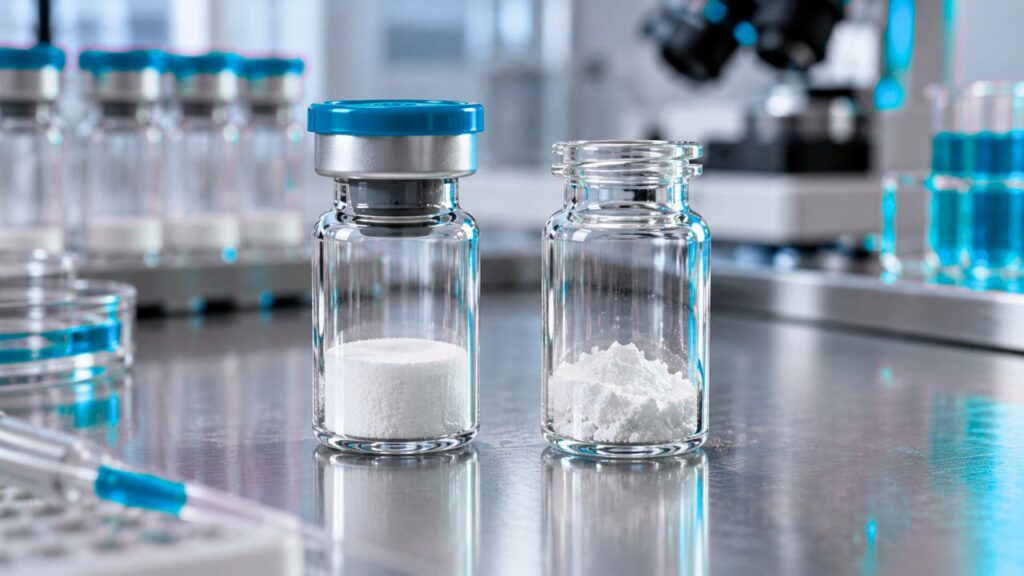
A sealed vial with a known storage history is easier to evaluate than one that has been opened repeatedly.
A sealed container helps control:
- moisture
- oxygen
- contamination
- environmental exposure
Once a container has been opened, storage history becomes more important.
For example, an opened vial that has repeatedly moved between cold storage and a humid laboratory environment has a different risk profile from an unopened vial kept continuously under controlled conditions.
The main risk is not simply the number of days since the vial was opened. It is the combination of moisture exposure, temperature, oxygen and handling conditions.
Does A Short Period Outside Cold Storage Ruin A Lyophilised Peptide?
Not necessarily.
A brief temperature excursion does not automatically mean that a lyophilised research sample has degraded.
What matters is:
- how high the temperature became
- how long the material remained there
- whether the vial stayed sealed
- whether moisture was introduced
- the stability characteristics of that particular peptide
A few hours in a controlled laboratory environment is very different from prolonged storage in a warm or humid area.
Where the storage excursion falls outside the documented conditions, laboratory records and analytical verification are more useful than simply judging the vial by appearance.
Is It Safe to Use Peptides with Visible Changes?
Visible changes can provide useful warning signs.
Researchers may notice:
- unusual clumping
- moisture inside the vial
- changes in the dried cake
- unexpected discolouration
- damage to the closure
- evidence that the vial is no longer properly sealed
These changes should be investigated before the material is used for analytical work.
However, normal appearance does not prove that the peptide is unchanged.
Chemical degradation may occur without producing any obvious visual difference.
Where sample integrity is important, chromatographic or mass-spectrometric analysis may be required.
USP peptide reference-standard work, for example, uses techniques including HPLC and mass spectrometry alongside other quality measurements. (PubMed Central (PMC))
What To Check Before Using an Older Peptide Vial?
Before deciding whether an older lyophilised peptide sample remains suitable for laboratory analysis, check the available records.
Start with the batch storage instructions. These should take priority over generic storage recommendations.
Then review the storage history. Look for temperature excursions, repeated handling or any period where storage conditions are unknown.
Check the container and seal for visible damage, moisture ingress or abnormal changes.
Review the COA and batch documentation for applicable storage or retest information.
Finally, consider analytical verification where sample integrity matters.
Depending on the research protocol, methods such as HPLC or mass spectrometry may help identify changes in purity or molecular composition.
So, How Long Do Lyophilised Peptides Last?
There is no reliable universal number.
For research peptide standards, periods beyond six months are generally considered long-term storage, with lyophilised storage at −20°C to −80°C recommended in published laboratory guidance.
But a vial should not be considered suitable simply because it falls inside a particular time window.
The best approach is:
known batch + correct storage + intact container + documented stability
Where one of those elements is missing, further assessment may be appropriate.
The expiry or retest period supported by the relevant batch documentation should always take priority over general storage advice.
FAQ
Do lyophilised peptides expire?
Yes. Lyophilisation can greatly improve stability, but dry peptide material can still undergo gradual chemical or physical changes. Batch-specific expiry or retest information should be followed where available.
Can lyophilised peptides last longer than six months?
They can. Published laboratory recommendations specifically discuss lyophilised storage for periods longer than six months, but the actual stability period remains peptide- and formulation-dependent.
Should lyophilised peptides be stored frozen?
Long-term storage guidance for laboratory peptide standards commonly uses temperatures between -20°C and -80°C. The storage instructions supplied for the specific research material should take priority.
Does room-temperature exposure destroy a lyophilised peptide?
A short temperature excursion does not automatically indicate degradation. Duration, temperature, moisture exposure and the particular peptide’s stability all need to be considered.
Does an unopened vial last longer?
An unopened vial normally offers better control of moisture and oxygen exposure. Once a vial is opened, handling conditions and humidity become more important factors.
“This article is for educational and research information only. Products discussed are intended for laboratory research use only and are not for clinical, food, cosmetic, veterinary, or household applications.”
Sources
- United States Pharmacopeia – Reference Standards to Support Quality of Synthetic Peptide Therapeutics: USP peptide reference standards research
- National Institute of Standards and Technology – RM 8327 Peptide Reference Material for Molecular Mass and Purity Measurements: NIST RM 8327 certificate
- International Council for Harmonisation – Q1A(R2): Stability Testing of New Drug Substances and Products: ICH Q1A(R2) stability guideline
- National Library of Medicine / PMC – Recommendations for the generation, quantification, storage and handling of peptides used for mass spectrometry-based assays: Peptide storage and handling recommendations
- PubMed – Solid-state chemical stability of proteins and peptides: Solid-state peptide stability review