Peptides vs Amino Acids: What’s the Difference?
🤝 Our content is written by humans, not AI robots.
If a laboratory catalogue lists amino acids and peptides alongside one another, the distinction can seem less obvious than it actually is.
Both involve amino acids, and their names can sometimes look similar, but they are not the same type of research material.
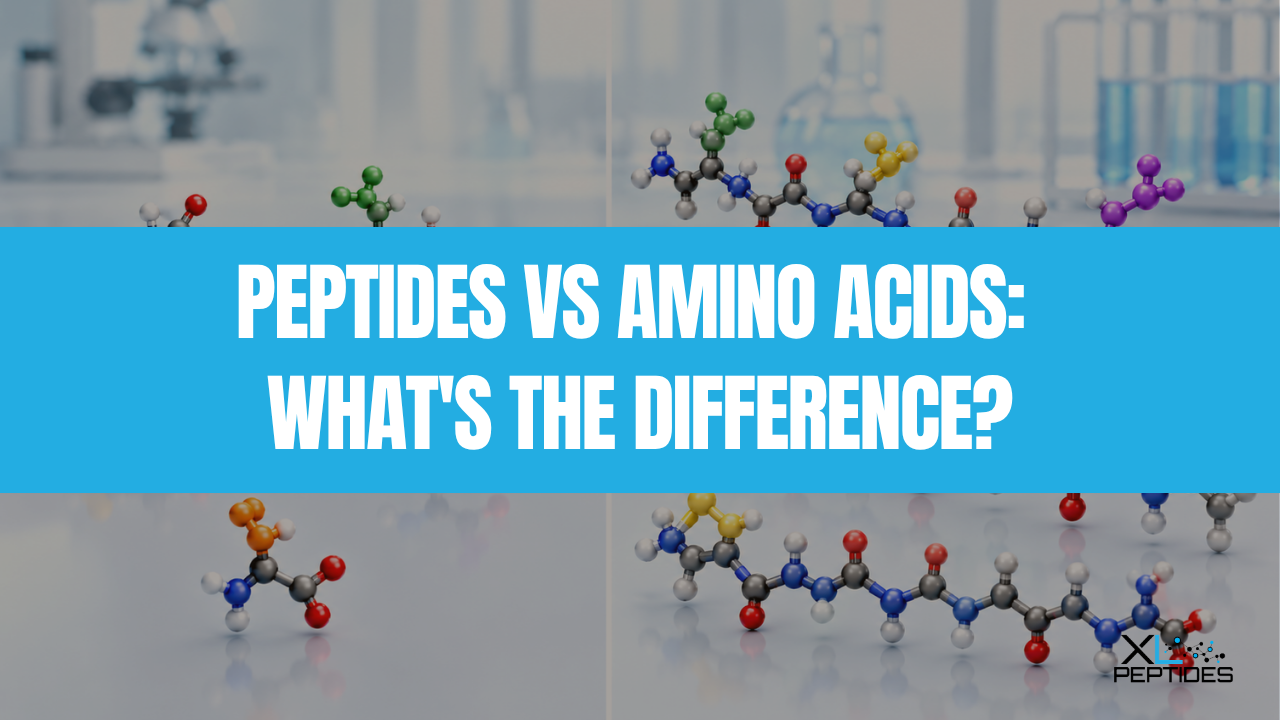
In simple terms, an amino acid is an individual chemical building block, while a peptide contains two or more amino acid residues joined together by peptide bonds.
For laboratory research, this difference matters because it affects the material’s chemical identity, sequence, molecular weight, and the information to be checked before preparing a sample.
Peptides vs Amino Acids
Amino acids are individual organic molecules containing characteristic amino and carboxyl functional groups.
Different amino acids have different side chains, often referred to as R groups, which give them distinct chemical properties.
When amino acids are chemically joined, a covalent bond can form between the carboxyl group of one amino acid and the amino group of another. This is known as a peptide bond.
Once incorporated into a peptide chain, the individual units are more accurately described as amino acid residues rather than as separate amino acid molecules.
The important point is that a peptide is not simply a larger version of one amino acid. It is a distinct molecular structure formed by a particular arrangement of residues.
| Feature | Amino Acid | Peptide |
| Basic structure | Individual amino acid molecule | Two or more amino-acid residues linked together |
| Peptide bonds | Not required | Present between residues |
| Sequence | No peptide sequence | Has a defined residue sequence |
| Molecular weight | Depends on the individual amino acid | Depends on sequence, length and modifications |
| Identification | Based on individual chemical identity | Often includes sequence, molecular weight and peptide identity |
| Research documentation | Compound-specific | Often includes sequence and peptide-specific analytical data |
Why Does A Peptide Have A Sequence?
This is one of the most useful ways to separate the two concepts.
An individual amino acid does not have an amino-acid sequence. It is one molecule.
A peptide contains multiple residues arranged in a particular order.
For example, a chain containing glycine, alanine and serine in one order is chemically different from a chain containing those same residues in another order.
Peptide chains also have directionality, with an N-terminus at one end and a C-terminus at the other. Sequences are conventionally written from the N-terminus towards the C-terminus.
This means that when checking a peptide research material, simply knowing which amino acids are present is not enough. Their order matters too.
What Happens When Amino Acids Form A Peptide?
During peptide bond formation, the carboxyl group associated with one amino acid reacts with the amino group associated with another.
A water molecule is formally lost during this process, producing the covalent peptide linkage between the two units.
IUPAC therefore describes the units remaining in the resulting chain as amino acid residues.
Two linked residues can form a dipeptide. Adding further residues creates progressively longer peptide chains.
This does not mean that every chain has identical chemical behaviour. The exact sequence and composition of a peptide can change properties relevant to laboratory preparation and analysis.
Molecular Weight of Peptides and Amino Acids
An amino acid has its own defined molecular formula and molecular weight.
A peptide’s molecular weight depends on several factors, including:
- The number of residues in the sequence
- Which amino acids are present
- Their sequence
- Terminal groups
- Any specified chemical modifications
Because water is formally lost when peptide bonds are formed, simply adding the molecular weights of the free amino acids does not yield the final peptide molecular weight without accounting for the water loss.
For laboratory research, the molecular weight stated in batch documentation should therefore relate to the finished peptide structure rather than merely the sum of its starting amino acids.
Why The Difference Matters In Laboratory Research
When receiving research material, first establish exactly what it is.
For a single amino acid, identification may focus on the compound name, molecular formula, molecular weight and analytical specifications.
For a peptide, additional information can be particularly important, such as its sequence, terminal configuration and any specified modifications.
Peptide sequence is part of its primary chemical identity. Changing the order of residues changes the sequence and therefore produces a different molecular structure.
For this reason, two peptide materials should not be considered equivalent simply because they contain the same types or number of amino-acid residues.
What To Check On Research Material Documentation
Before preparing material for a controlled research setting, check the supplied documentation carefully.
Useful information includes:
- Full research material name
- Amino-acid sequence, where applicable
- Molecular formula or molecular weight
- Batch or lot number
- Certificate of Analysis (COA)
- Stated purity
- Analytical identification data
- Specified modifications or terminal groups
- Storage and handling instructions supplied for that material
The main point is to verify the actual chemical identity, rather than assuming that materials with similar names are interchangeable.
Laboratory protocols should also follow the documentation supplied for the specific batch and material.
Frequently Asked Questions
Are Peptides The Same As Amino Acids?
No. Amino acids are individual molecules, while peptides contain two or more amino-acid residues joined by peptide bonds.
Are Peptides Made From Amino Acids?
Yes. Peptide structures are formed when amino-acid units are linked through covalent peptide bonds.
What Is An Amino-Acid Residue?
An amino-acid residue is the part of an amino acid that remains incorporated into a peptide after peptide bond formation.
What Is A Peptide Bond?
A peptide bond is a covalent amide linkage formed between the carbonyl carbon associated with one amino acid and the nitrogen associated with another.
Does An Amino Acid Have A Sequence?
An individual amino acid does not have a peptide sequence. A sequence becomes relevant when multiple amino-acid residues are arranged within a peptide chain.
Can Two Peptides Contain The Same Amino Acids But Be Different?
Yes. The order of the residues matters, so changing the sequence produces a different molecular structure.
Is Molecular Weight Enough To Identify A Peptide?
Not by itself. Molecular weight is useful analytical information, but sequence, batch documentation and appropriate analytical data should also be considered when confirming research material identity.
Compliance Note
“This article is for educational and research information only. Products discussed are intended for laboratory research use only and are not for clinical, food, cosmetic, veterinary, or household applications.”
Sources
IUPAC Gold Book – Amino-Acid Residue