When looking at a peptide specification sheet or Certificate of Analysis (COA), you may see a short string of letters such as AGSLK. At first glance, it can look like a code with little practical meaning.
That code is the peptide sequence. It shows which amino acids make up the peptide and, importantly, the exact order in which they are connected.
In laboratory research, the sequence is one of the most fundamental pieces of information used to identify and document peptide research materials.
What Is a Peptide Sequence?
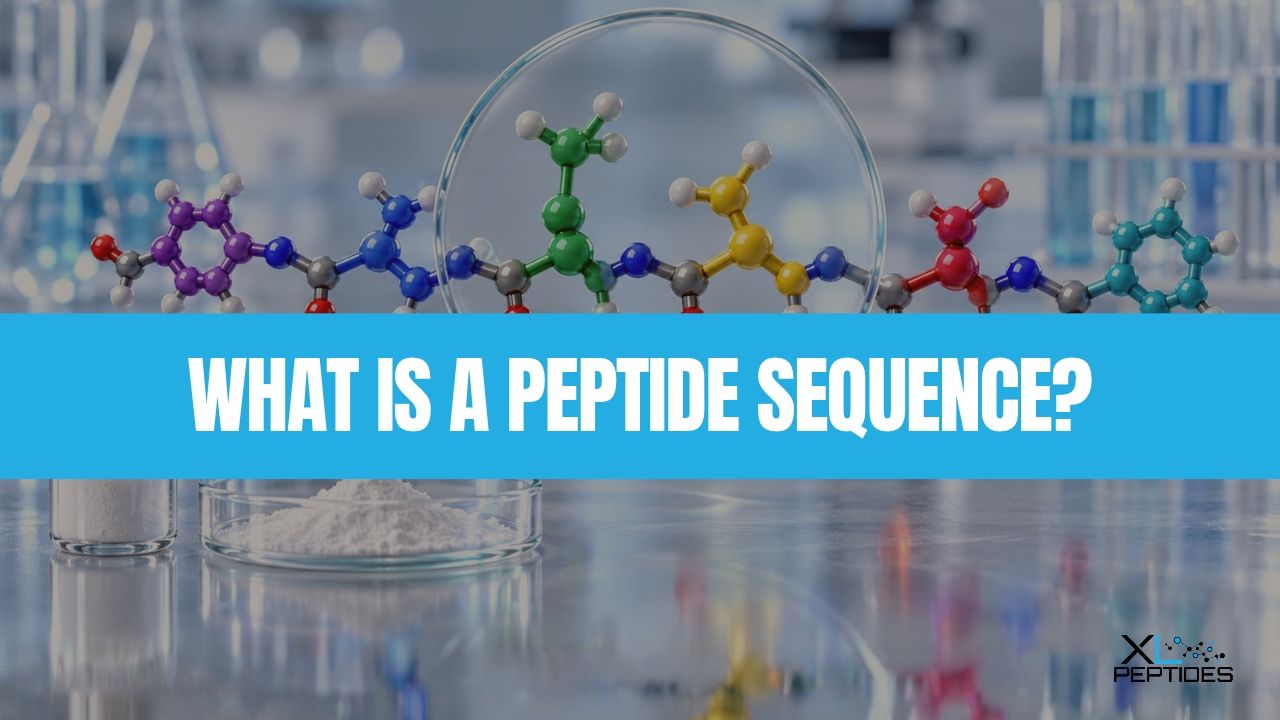
A peptide sequence is the ordered arrangement of amino acids joined together by peptide bonds.
In simple terms, imagine several different building blocks connected in a line. The peptide sequence tells you which building block comes first, which comes second, and so on.
For example, a simple sequence could be written as:
Ala-Gly-Ser-Leu-Lys
The same sequence can be written using the standard one-letter amino acid notation:
AGSLK
The important point is that order matters. A material containing the same amino acids arranged differently would have a different sequence.
The linear amino acid sequence is also known as the peptide’s primary structure.
How Are Peptide Sequences Written?
Researchers commonly use either three-letter or one-letter abbreviations for amino acids.
For example:
Alanine = Ala = A
Glycine = Gly = G
Serine = Ser = S
Leucine = Leu = L
Lysine = Lys = K
One-letter notation is particularly useful when sequences become longer because it keeps documentation compact. Standardised one-letter amino acid notation has been established through biochemical nomenclature conventions.
Unless stated otherwise, peptide sequences are conventionally written from the N-terminus to the C-terminus, meaning the N-terminal amino acid appears on the left, and the C-terminal amino acid appears on the right.
For laboratory documentation, this direction matters when comparing specifications or entering sequences into analytical software.
Why Does The Order Of Amino Acids Matter?
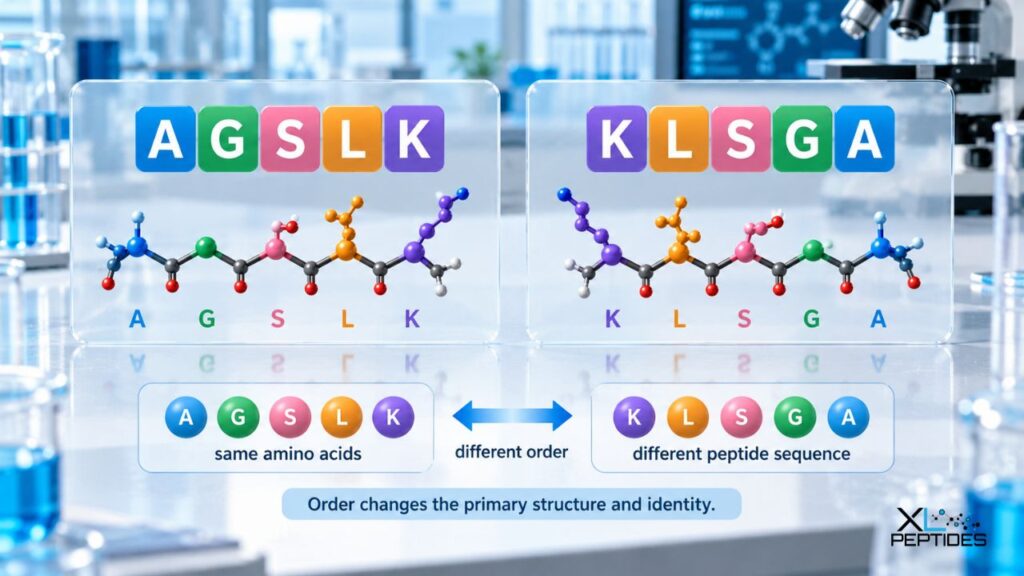
Consider these two sequences:
AGSLK
and
KLSGA
They contain exactly the same five amino acids, but they are not the same peptide sequence.
Changing the order changes the peptide’s primary structure.
The sequence also contributes to measurable chemical characteristics of a peptide research material, including its calculated molecular mass and other sequence-dependent properties.
This is why checking only the number or types of amino acids is not enough when confirming research material identity.
Peptide Sequence Vs Molecular Weight
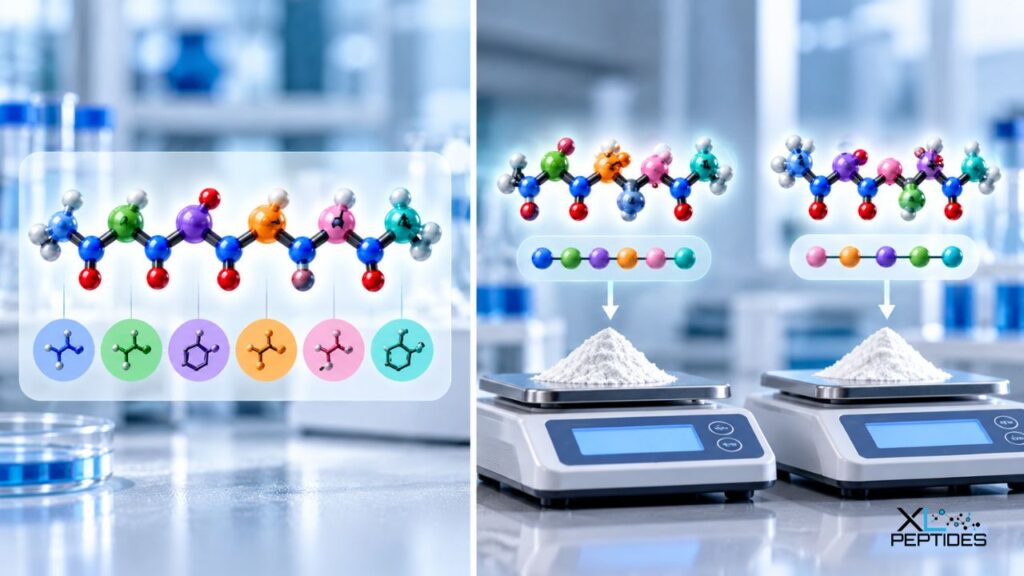
A peptide sequence and molecular weight provide different information.
The sequence tells you which amino acids are present and their order.
Molecular weight is the calculated or measured mass of a molecule.
Once a sequence is known, laboratory software can calculate a theoretical molecular mass from it.
Resources such as ExPASy’s PeptideMass accept amino acid sequences in one-letter notation and calculate theoretical masses.
However, the reported mass may also depend on modifications or other structural details included in the research material.
This means sequence information and molecular weight should normally be interpreted together rather than treated as interchangeable values.
What About Modified Peptide Sequences?
A peptide may contain additional chemical modifications that are not obvious from the basic amino acid sequence alone.
Laboratory databases and analytical tools may therefore show annotations alongside particular residues or at the peptide termini.
For example, sequence-analysis systems can record modifications to individual amino acids rather than change the underlying one-letter sequence itself.
ExPASy’s documentation demonstrates this by placing modification annotations beside the relevant residue.
The important point is that the base sequence does not always describe every chemical feature of the final research material.
When checking laboratory records, review the full product specification rather than relying on the sequence alone.
Where Can You Find A Peptide Sequence?
For laboratory research materials, sequence information may appear in the product specification, COA, technical documentation, or associated batch records.
When comparing records, check that the sequence is written in the same direction and notation before assuming there is a discrepancy.
For example, one document may use:
Ala-Gly-Ser-Leu-Lys
while another uses:
AGSLK
These represent the same amino acid sequence.
What To Check When Reviewing A Peptide Sequence
Start by checking the sequence against the research material’s batch documentation or specification.
Then confirm whether one-letter or three-letter notation is being used and whether the sequence runs from the N-terminus to the C-terminus.
It is also worth checking for documented terminal changes or other modifications, particularly if the theoretical molecular weight does not initially match the value shown elsewhere in the documentation.
Finally, do not confuse sequence confirmation with purity testing. A sequence describes molecular identity, whereas purity is a separate analytical measurement.
Where identity needs to be confirmed experimentally, laboratories may use analytical techniques appropriate to their established protocol and research requirements.
Why Sequence Information Matters In Laboratory Documentation
A peptide name alone may not provide all the information needed to describe a research material precisely.
Sequence information provides a direct description of the amino acid sequence and can therefore be useful when reviewing technical specifications, comparing records, calculating theoretical molecular properties, or preparing analytical documentation.
It can also help prevent simple mistakes where similarly named materials have different sequences.
For research handling, the practical approach is to keep the peptide sequence together with the COA, batch number, molecular weight information and other relevant laboratory documentation.
Frequently Asked Questions
What Is A Peptide Sequence In Simple Terms?
A peptide sequence is the exact order of amino acids connected together in a peptide. It is essentially a molecular identification code for the peptide’s primary structure.
Why Are Peptide Sequences Written As Letters?
Each standard amino acid has an internationally recognised one-letter abbreviation. This allows longer sequences to be recorded more compactly.
Which Direction Is A Peptide Sequence Read?
By convention, peptide and polypeptide sequences are normally written from the N-terminus on the left towards the C-terminus on the right.
Can Two Peptides Contain The Same Amino Acids But Have Different Sequences?
Yes. If the amino acids appear in a different order, the sequence is different even when the overall amino acid composition is the same.
Is Peptide Sequence The Same As Molecular Weight?
No. Sequence describes the order of amino acids, while molecular weight describes molecular mass. The amino acid sequence can be used to calculate a theoretical molecular weight.
Is Peptide Sequence The Same As Purity?
No. Sequence relates to molecular identity and to the order of amino acids. Purity indicates how much of a laboratory sample corresponds to the target material relative to other detected components.
Can A Peptide Sequence Include Modifications?
The underlying sequence represents the amino acid order, while additional notation may be used to identify chemical modifications associated with particular residues or peptide termini.
Research Use Note
This article is for educational and research information only. Products discussed are intended for laboratory research use only and are not for clinical, food, cosmetic, veterinary, or household applications.
Sources
IUPAC – A One-Letter Notation for Amino Acid Sequences