A peptide sequence may look like a simple row of amino-acid abbreviations.
However, each amino acid must be joined to the next through a carefully controlled chemical reaction.
The connection created during this reaction is called a peptide bond.
It forms the backbone of every peptide research material, holding the individual amino-acid residues together in a specific order.
What Is a Peptide Bond?
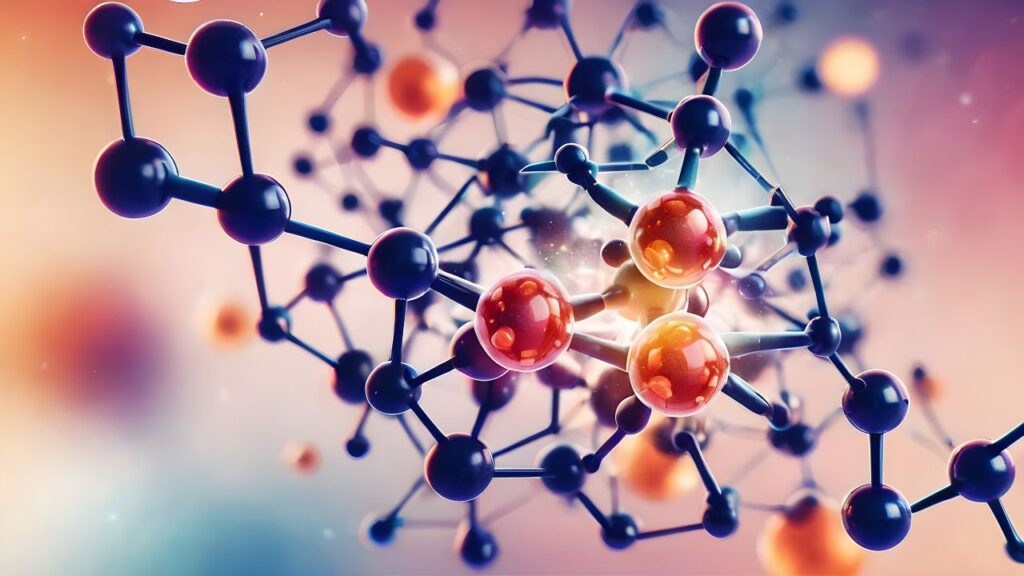
A peptide bond is a strong covalent bond formed between two amino acids.
More specifically, the carboxyl group of one amino acid reacts with the amino group of another.
The resulting connection has the structure:
–C(=O)–NH–
During this process, the elements of one water molecule are formally removed. For this reason, peptide bond formation is often described as a condensation reaction.
Once an amino acid becomes part of the chain, the remaining unit is called an amino acid residue.
In simple terms, the peptide bond acts like a link between two building blocks. Repeating the reaction produces a longer peptide chain.
Does Mixing Amino Acids Form Peptide Bonds?
Not efficiently.
Although peptide bond formation is commonly shown as two amino acids joining while releasing water, simply mixing free amino acids in a research solution will not normally produce a controlled peptide sequence.
The important point is that the carboxyl group usually needs to be activated before it reacts efficiently with the required amino group. Other reactive parts of the amino acids may also need to be temporarily protected.
Without these controls, a laboratory may obtain incomplete reactions, unwanted linkages or a mixture of different products.
How Peptide Bonds Are Formed During Laboratory Synthesis
A widely used laboratory approach is solid-phase peptide synthesis, often shortened to SPPS.
The method was introduced by R. Bruce Merrifield and involves building a peptide step by step while it remains attached to a solid support.
A simplified laboratory workflow looks like this:
1. Attach the First Amino Acid
The first protected amino acid is attached to a solid resin. This resin keeps the growing peptide chain in place during repeated reaction and washing stages.
2. Remove the Temporary Protecting Group
The amino group needed for the next reaction is uncovered through a controlled deprotection step.
Other reactive areas remain protected so they do not form unwanted bonds.
3. Activate the Next Amino Acid
The carboxyl group of the incoming amino acid is treated with suitable coupling reagents. Activation makes it more reactive and prepares it for peptide bond formation.
4. Carry Out the Coupling Reaction
The activated amino acid reacts with the exposed amino group on the resin-bound chain.
If the reaction proceeds correctly, a new peptide bond is formed.
5. Wash and Repeat
Excess reagents and reaction by-products are removed. The deprotection, activation and coupling cycle is then repeated for each remaining amino acid in the sequence.
In standard solid-phase synthesis, the chain is generally assembled from the C-terminal end towards the N-terminal end.
6. Cleave and Purify the Material
After the sequence has been completed, the research material is removed from the resin. Remaining side-chain protecting groups are also removed according to the validated laboratory protocol.
The crude material can then be purified and analysed before it is accepted as a completed research batch.
Common Peptide Bond Formation Problems
Incomplete Coupling
An incomplete reaction can leave some chains without the newly added amino acid. This may produce shorter deletion sequences in the crude research material.
Possible laboratory causes include:
- Aged or moisture-exposed reagents
- Insufficient activation
- Limited access to the growing chain on the resin
- A coupling period that is too short
- Steric hindrance around bulky amino-acid residues
Any adjustment should follow the laboratory protocol. This may involve preparing fresh reagents, extending the documented coupling period or carrying out a validated repeat coupling.
Unexpected Side Products
Side products may appear when protection is incomplete, activation conditions are poorly controlled or the reaction mixture is left for longer than the protocol allows.
Careful batch documentation is important. Reagent lot numbers, reaction times, temperatures and deviations should be recorded so that unexpected analytical results can be investigated.
Difficult Longer Sequences
As a peptide chain becomes longer, it may fold or aggregate on the resin. This can make the reactive end less accessible to the incoming amino acid.
The main risk is that a reaction may appear complete while a portion of the resin-bound material has coupled poorly. Validated resin choice, solvent conditions and sequence-specific laboratory methods can help manage this issue.
How Is Bond Formation Checked?
No single observation confirms every part of a completed sequence.
Laboratories commonly combine in-process reaction checks with final analytical testing.
Reversed-phase HPLC can help separate the intended material from impurities, while mass spectrometry can check whether the measured molecular mass agrees with the expected sequence.
NIST reference peptide materials, for example, are prepared and characterised using techniques including solid-phase synthesis, HPLC purification and mass-spectrometric analysis.
A correct mass alone does not automatically prove that a batch is sufficiently pure. Purity, identity and batch history should be reviewed together under the laboratory’s quality procedure.
Summary
Peptide bond formation is chemically simple to describe but more demanding to control in practice.
One amino acid must be activated, the correct reaction sites must remain available, unwanted reactions must be limited, and every coupling stage must be documented.
Small problems repeated across several cycles can produce substantial differences in the final research material.
For controlled laboratory research, careful coupling, washing, protection, purification and analytical review are therefore all part of the same process.
Note: This article is for educational and research information only. Products discussed are intended for laboratory research use only and are not for clinical, food, cosmetic, veterinary, or household applications.
Sources
- IUPAC Gold Book – Peptides and Peptide Bond Terminology
- IUPAC Gold Book – Amino-Acid Residue Definition
- Merrifield, R. B. – Solid Phase Peptide Synthesis: The Synthesis of a Tetrapeptide
- Nissen, P. et al. – The Structural Basis of Ribosome Activity in Peptide Bond Synthesis
- NIST Reference Material 8327 – Synthetic Peptide Preparation and Characterisation