If a research peptide arrives as a dry powder or compact material at the bottom of a vial, it may look quite different from the liquid samples commonly handled in a laboratory.
In many cases, that dry material has been lyophilised, or freeze-dried.
Lyophilisation is widely used to remove water from sensitive research materials while limiting exposure to high temperatures.
For peptides, this can make laboratory storage and sample handling more manageable, but it does not make the material immune to degradation.
What does lyophilised mean?
Lyophilised simply means freeze-dried.
During lyophilisation, a peptide-containing solution is frozen, and most of its water is removed under reduced pressure.
Rather than melting first, the frozen water changes directly from ice into water vapour, a process called sublimation.
The finished research material is left in a dry, solid form, often appearing as a powder, a porous mass, or a small “cake” inside the vial.
The important point is that lyophilisation is not the same as simply allowing a liquid to dry.
It is a controlled laboratory process designed to remove water under carefully managed temperature and pressure conditions.
How are peptides lyophilised?
Although commercial freeze-drying systems can be complex, the basic process has three main stages.
1. Freezing
The peptide formulation is first cooled until the solution freezes.
2. Primary drying
Pressure is reduced inside the freeze-dryer. Under these conditions, frozen water can leave the sample through sublimation, moving directly from solid ice to vapour.
This stage removes most of the frozen water.
3. Secondary drying
A smaller amount of water can remain associated with the dried material after primary drying. Secondary drying helps remove more of this residual moisture through desorption.
The result is a substantially dried peptide preparation that can be sealed for controlled laboratory storage.
Why are research peptides supplied in lyophilised form?
Water can influence many chemical and physical degradation processes.
Removing most of it can therefore improve the storage stability of some peptide and protein preparations compared with keeping the same material continuously in aqueous solution.
Lyophilisation can also make research materials more convenient to store, document and prepare when a laboratory protocol requires a solution at a later stage.
However, dry does not mean indestructible.
Freeze-drying itself exposes molecules to stresses including freezing, changes in solute concentration and dehydration.
Formulation conditions, therefore, matter, and correctly designed lyophilisation cycles may include stabilising excipients where appropriate.
In simple terms, lyophilisation can improve stability, but it does not guarantee unlimited stability.
Lyophilised peptide vs peptide research solution
The difference matters when planning laboratory storage.
A lyophilised peptide contains relatively little water and remains in a dry state.
A prepared research solution contains a solvent, meaning the peptide is once again in an aqueous or other liquid environment.
These two forms should not automatically be treated as having the same storage requirements or stability period.
Once a lyophilised sample has been prepared as a research solution, laboratories should follow the validated protocol and batch-specific guidance for that liquid preparation rather than relying on instructions intended for the dry material.
What should a lyophilised peptide look like?
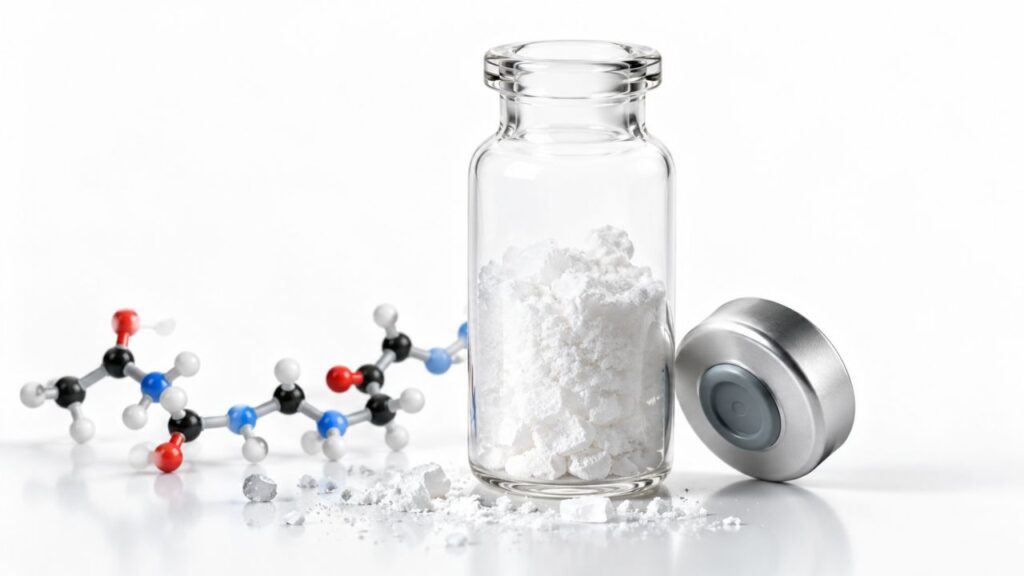
There is no single appearance that every freeze-dried peptide must have.
Depending on the peptide, concentration, excipients and freeze-drying process, the material might appear as:
- A compact cake
- A loose powder
- A porous or fluffy solid
- Material is partly attached to the sides or bottom of the vial
- A cake containing small cracks or irregularities
This does not mean that every visual difference indicates degradation.
The FDA’s technical guidance on lyophilisation, however, identifies cake appearance and moisture-related changes, such as collapse or “meltback,” as useful quality observations.
Improper drying can leave pockets of moisture and may affect stability.
Appearance should therefore be treated as a screening observation, not as proof of identity, purity or stability.
Does a broken or powdery cake mean the peptide is damaged?
Not necessarily.
A freeze-dried cake can break apart during transport or handling without automatically indicating a chemical change in the peptide.
Physical appearance is influenced by formulation composition and the lyophilisation process itself.
A more useful approach is to examine the full history of the research material rather than judging it solely by its appearance.
How should lyophilised peptides be stored for research?
There is no universal storage temperature that applies to every peptide.
Storage requirements can vary according to peptide sequence, formulation, moisture content, container system and stability data.
Temperature and residual moisture can both influence the stability of freeze-dried materials.
For research storage, the practical approach is to:
- Follow the storage conditions supplied with the specific batch.
- Keep the container properly sealed.
- Minimise unnecessary exposure to moisture.
- Protect the research material from inappropriate heat or light where specified.
- Record significant storage excursions.
- Avoid assuming that lyophilisation automatically makes room-temperature storage suitable.
The main risk is assuming that all dry peptides behave in exactly the same way. They do not.
Frequently Asked Questions
Are lyophilised peptides the same as freeze-dried peptides?
Yes. Lyophilised and freeze-dried describe the same general process of freezing a material and removing water under reduced pressure.
Are lyophilised peptides always powders?
No. They may appear as loose powder, a porous cake or another dry solid form depending on the formulation and freeze-drying process.
Are lyophilised peptides more stable than peptide solutions?
Lyophilisation can improve the storage stability of many sensitive materials by reducing their water content, but the extent of this improvement is peptide- and formulation-specific.
Do lyophilised peptides still need controlled storage?
Usually, yes. Freeze-drying does not remove the need to follow batch-specific temperature, moisture and light-control requirements.
Can moisture damage a lyophilised research sample?
Moisture can influence the physical and chemical stability of freeze-dried materials, so maintaining the specified container and storage conditions is important.
Does a cracked lyophilised cake mean the peptide has degraded?
Not automatically. Physical appearance alone cannot establish peptide integrity, so storage history, batch documentation and analytical data should also be considered.
Can a lyophilised peptide still degrade?
Yes. Lyophilisation can improve stability but does not prevent all degradation pathways. Storage conditions and the properties of the individual peptide remain important.
Research Use Notice
“This article is for educational and research information only. Products discussed are intended for laboratory research use only and are not for clinical, food, cosmetic, veterinary, or household applications.”
Sources
- U.S. Food and Drug Administration – technical overview of lyophilisation:
https://www.fda.gov/inspections-compliance-enforcement-and-criminal-investigations/inspection-guides/lyophilization-parenteral-793 - Practical advice on the development and control of lyophilised formulations – PubMed Central:
https://pmc.ncbi.nlm.nih.gov/articles/PMC11744310/ - Process and formulation effects on molecular structure in lyophilised solids – PubMed Central:
https://pmc.ncbi.nlm.nih.gov/articles/PMC4846509/ - Influence of moisture content and temperature on freeze-dried material stability – PubMed Central:
https://pmc.ncbi.nlm.nih.gov/articles/PMC7238084/ - United States Pharmacopeia – peptide standards and analytical characterisation:
https://www.usp.org/biologics/peptides