As a general research-storage principle, dry lyophilised peptides may remain stable at room temperature for short periods, often described as days to weeks when kept dry, sealed, and protected from bright light.
However, room temperature is not usually preferred for long-term storage.
Peptides are chemically diverse molecules. Some are relatively stable in dry form, while others are more sensitive due to specific amino acid residues or structural features.
This is why batch-specific storage guidance should always be treated as the primary reference.
What are peptides?
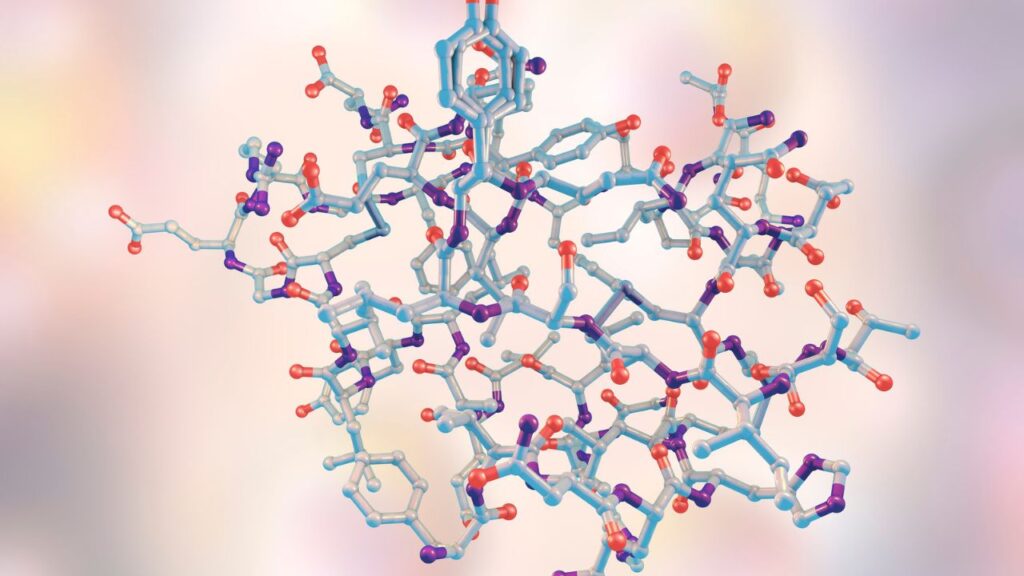
Peptides are short chains of amino acids joined by peptide bonds. They are smaller than many proteins and can vary widely in length, charge, solubility, structure, and stability.
In research environments, peptides may be used as analytical standards, assay materials, receptor-binding tools, or model compounds for studying biochemical processes.
Their behaviour can differ significantly depending on the sequence and the conditions under which they are stored.
Because peptides are not all chemically identical, there is no single room-temperature stability period that applies to every peptide material.
How long do peptides last at room temperature?
For dry lyophilised peptides, room-temperature stability is often limited to short-term handling, transport, or temporary storage. Under dry, light-protected conditions, some peptides may remain stable for days to weeks.
However, this should not be interpreted as a fixed shelf life. Stability can change depending on the peptide sequence, residual moisture, vial seal, temperature fluctuations, humidity, oxygen exposure, and the presence of sensitive amino acid residues.
For longer-term research storage, colder conditions are generally preferred. Many peptide suppliers and laboratory references recommend storing dry peptide materials at freezer temperatures for maximum stability.
Why researchers study room-temperature peptide stability

Room-temperature stability matters because laboratory materials may be exposed to ambient conditions during transport, inspection, weighing, or short-term bench handling.
Researchers study peptide stability to understand whether the material remains chemically consistent over time.
If a peptide degrades, absorbs moisture, oxidises, or aggregates, the material used in an assay may no longer match the original batch profile.
This can affect reproducibility. A sample stored under controlled cold conditions may produce different analytical results from a sample exposed to room temperature, humidity, or light for an extended period.
Scientific mechanisms and pathways affecting stability
Peptides can degrade through several chemical and physical pathways. These pathways are influenced by the peptide sequence and the storage environment.
Hydrolysis
Hydrolysis is a water-related degradation process. When moisture is present, some peptide bonds or side-chain groups may become more vulnerable to chemical change. This is one reason dry storage is important for lyophilised research materials.
Oxidation
Certain amino acid residues, including cysteine, methionine and tryptophan, are more prone to oxidation.
Oxygen exposure, light, trace contaminants, and storage conditions can influence oxidative changes.
Oxidation may alter the peptide’s analytical profile and can affect consistency in laboratory assays.
Deamidation
Deamidation can occur in peptides containing residues such as asparagine or glutamine. This process can change charge, structure, and analytical behaviour. Temperature and pH can influence the rate of deamidation.
Aggregation
Some peptides may self-associate or form aggregates. Aggregation may be influenced by concentration, pH, sequence, temperature, surface contact, and storage form. This can affect solubility and analytical consistency.
Moisture uptake
Many peptide materials are hygroscopic, meaning they can absorb moisture from the surrounding environment.
Moisture uptake can reduce long-term stability and may change the apparent peptide content of a stored material.
Lyophilised peptides vs liquid research preparations
The form of the peptide is one of the biggest factors in room-temperature stability.
Dry lyophilised peptides are usually more stable than liquid research preparations because much of the water has been removed. Lower water content can slow several degradation processes.
Liquid research preparations are generally more sensitive. They may be more affected by pH, temperature, oxidation, microbial contamination risk in non-sterile research environments, and physical changes such as aggregation or precipitation.
For this reason, room-temperature exposure is usually a greater concern for liquid peptide preparations than for unopened, dry, lyophilised materials.
What affects how long peptides last at room temperature?
Several factors influence room-temperature stability.
Peptide sequence
Amino acid composition matters. Peptides containing oxidation-sensitive or deamidation-prone residues may require more careful storage.
Moisture exposure
Moisture can greatly reduce the stability of dry peptide materials. Opening a cold vial before it has equilibrated to room temperature can encourage condensation.
Light exposure
Bright light can contribute to degradation in light-sensitive peptide materials. Light protection is often recommended for storage.
Oxygen exposure
Some peptides are sensitive to oxidation. Minimising unnecessary air exposure can help preserve analytical consistency.
Storage form
Dry lyophilised materials are usually more stable than liquid preparations. Liquid forms often have shorter practical stability windows.
Temperature fluctuation
Repeated changes between cold and room-temperature environments may increase condensation risk and contribute to instability.
Limitations of current research
There is no universal answer to how long peptides last at room temperature.
Stability is peptide-specific and depends on storage form, packaging, humidity, temperature, oxygen exposure, light exposure, and analytical testing method.
Supplier guidance may also vary by batch. A storage statement for one peptide should not automatically be applied to another.
Another limitation is that room-temperature conditions are not always consistent. A cool, dry laboratory bench is very different from a warm, humid environment. These differences can affect degradation rates.
For accurate research planning, laboratories should rely on peptide-specific documentation, Certificates of Analysis, and validated analytical testing where appropriate.
Final summary: how long do peptides last at room temperature?
In research settings, dry lyophilised peptides may remain stable for short periods, commonly described as days to weeks when kept sealed, dry, and protected from bright light.
However, room temperature should not be treated as ideal for long-term peptide storage. For longer periods, colder storage is generally preferred, especially for sensitive peptide sequences or materials intended for analytical consistency.
The most reliable approach is to follow batch-specific storage guidance, minimise exposure to moisture and light, and maintain consistent laboratory handling procedures.
Note: This article is for educational and research information only. Products discussed are intended for laboratory research use only and are not for clinical, food, cosmetic, veterinary, or household applications.
FAQ
Can dry peptides remain stable at room temperature?
Dry lyophilised peptides may remain stable at room temperature for short periods when kept sealed, dry, and protected from bright light. The exact stability period depends on the specific peptide and storage conditions.
Are liquid peptide preparations stable at room temperature?
Liquid research preparations are generally less stable than dry lyophilised materials. They may be more affected by temperature, pH, oxidation, aggregation, and other degradation pathways.
Why does moisture reduce peptide stability?
Moisture can contribute to hydrolysis and other chemical changes. It may also affect the measured peptide content of a dry material.
Does light affect peptide research materials?
Some peptide materials may be sensitive to light. Protecting samples from bright light can help reduce unwanted chemical changes during storage.
Why is peptide sequence important for storage stability?
Different amino acid residues have different chemical sensitivities. For example, some residues are more prone to oxidation or deamidation, which can influence storage stability.
What should researchers check before storing peptide materials?
Researchers should review the Certificate of Analysis, batch-specific storage guidance, purity data, packaging information, and any supplier notes related to moisture, light, and temperature sensitivity.
Sources
- National Human Genome Research Institute – Peptide Definition
https://www.genome.gov/genetics-glossary/Peptide - NCBI Bookshelf – Biochemistry, Peptide
https://www.ncbi.nlm.nih.gov/books/NBK562260/ - Bachem – Care and Handling of Peptides
https://www.bachem.com/knowledge-center/care-and-handling-of-peptides/ - NIBSC – Peptide Handling, Dissolution & Storage
https://nibsc.org/science_and_research/virology/cjd_resource_centre/available_samples/peptide_library/peptide_storage.aspx - Sigma-Aldrich / Merck – Handling and Storage Guidelines for Peptides and Proteins
https://www.sigmaaldrich.com/US/en/technical-documents/technical-article/research-and-disease-areas/cell-and-developmental-biology-research/handling-and-storage - PMC – Designing Formulation Strategies for Enhanced Stability of Peptides in Aqueous Solutions: A Review
https://pmc.ncbi.nlm.nih.gov/articles/PMC10056213/ - PMC – Factors Affecting the Physical Stability of Peptide Materials
https://pmc.ncbi.nlm.nih.gov/articles/PMC5665799/ - PubMed – Solid-State Chemical Stability of Proteins and Peptides
https://pubmed.ncbi.nlm.nih.gov/10229638/